
Shorter Cranks: A Trend or the New Standard?
When elite riders adopt new equipment or techniques in search of performance gains, the rest of us usually follow. The topic of the moment is crank length. Does it matter? Or more importantly, does it matter for you?
There’s an old saying ‘When America sneezes, the world catches a cold’. But if we may be so bold as to direct the metaphor towards a cycling context, it would sound something like ‘When Tadej adapts, the cycling world sits up and takes notice’.
This is certainly the case when it comes to crank length, after Tadej Pogačar – who in 2025 has already won the UAE Tour, Strade Bianche, Tour of Flanders, and the Tour de France – moved from a ‘standard’ crank length of 172.5mm to 170mm, and then in 2024 to 165mm. But tongues really started to wag this year when Jonas Vingegaard was spotted using tiny 150mm cranks at the Volta ao Algarve in February. Was he setting a new trend? Was he following Pogačar’s lead? Or was it all a double-bluff, to confuse everyone else?
“[It’s] very complex. Going shorter has a number of gains, but the trade-off is loss of torque.”
As with any new performance gains linked to equipment changes, the reasons behind those gains are varied and sometimes difficult to define. Just last year, South African sports scientist and Team UAE Emirates Head of Performance Dr Jeroen Swart weighed in on the debate via social media, stating: “[It’s] very complex. Going shorter has a number of gains: reduced inertial change per pedal stroke; more open hip angle; better corner clearance; faster time to peak power during acceleration; aero gains. But the trade-off is loss of torque.”
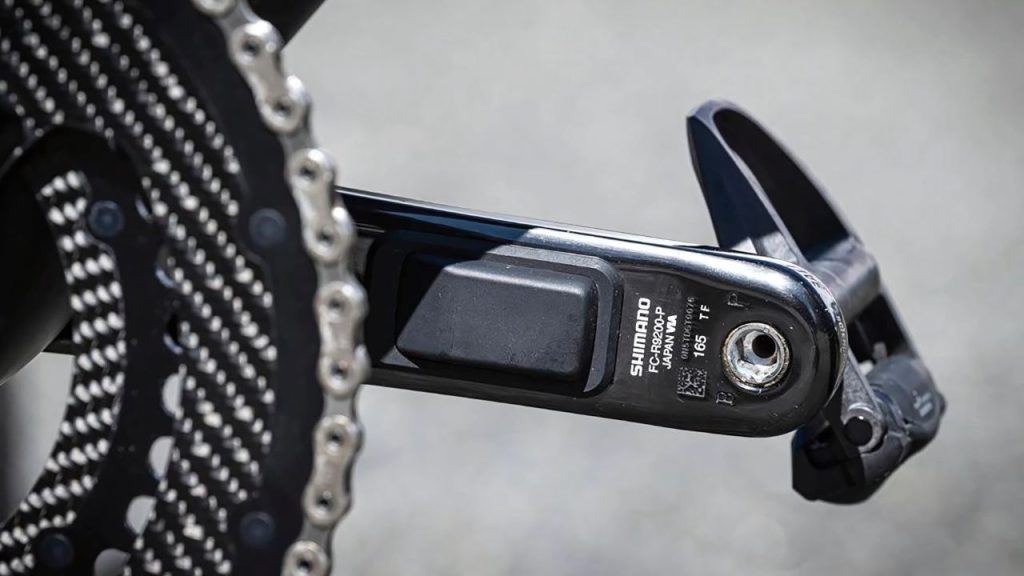
Brands such as Shimano have entered the fray, offering 160mm, 165mm and 167.5mm crank lengths in their Dura-Ace groupset, and 160mm and 165mm in Ultegra – alongside all the standard longer lengths. In a website statement, the company notes through Dave Lawrence, their North America Road Product Manager: “The idea is that we’re trying to help consumers and bike companies build up bikes for a wider range of heights and needs. We’ve seen no drawbacks in using shorter cranks.”
Long, short or just going round in circles?
One man convinced of the merits of shorter cranks is former SA National Road Champ, Olympian and now bike-shop owner and bike-fit guru David George. “The headline for me is that we had the wrong number for all these years,” he says. “Crank lengths of 170mm and 175mm are not efficient.”
George believes that standard lengths became ‘standard’ simply because they were first. “The numbers are a hundred years old. They happened without much science. Most competent bike fitters have been talking about the benefits of shorter cranks for about 10 years now.”
He adds that in the ‘old days’, when he was riding for the likes of US Postal Service, bike set-ups for the pros were normally handled by the team mechanics. “They would never go out of their way to offer you an option of something that was biodynamically or aerodynamically faster – because it meant they had to do more work!” he says with a laugh. “Now the dam has broken, because high-level athletes have started using shorter cranks. The benefits are so huge, and so numerous.
“And teams can no longer operate in old-school ways, where one or two riders are looked after and the rest are cannon fodder. Everyone is getting the best advice on nutrition, training and so on. So, now we have a situation where Tadej is the first – or one of the first – to go to 165mm; and that’s made everyone else on the World Tour scratch their heads and look at the benefits.”
RELATED: 30 Surprising Facts You Probably Didn’t Know About Your Bike’s Drivetrain
Trend-setter (and pace-setter) that he is, Pog isn’t the first elite rider to experiment with crank length. In a discussion with Road.cc, Phil Burt – who worked as a physio for British Cycling for 12 years and was a consultant physiotherapist for Team Sky – recalled how the aero benefits of shorter cranks were known to Team GB ahead of the 2016 Olympic Games in Rio. Burt and the support team wanted the riders on 165mm cranks at the Games; then former Tour de France winner Bradley Wiggins got wind of the ‘upgrade’.
As Burt told Road.cc, “Bradley heard that, and said to me, ‘I should change.’ He was on 177.5mm cranks and he dropped to 170mm in one go, then to 165mm the next day. He dropped his front end 30 millimetres and got a three-and-a-half percent drop in CdA [drag coefficient] on the track. That’s a man who won the Tour de France, right? Well – you wouldn’t say he had a bad position, would you?!”
Wiggins broke the Hour Record using 170mm cranks, and claimed a gold medal at Rio in the men’s team pursuit using 165mm cranks.
Reece McDonald, a senior coach at Science to Sport, South Africa’s globally recognised high-performance specialists, says that the crank debate has only really been discussed ad nauseam in elite circles; but he concedes it’s something recreational riders are wising up to.
“Most bikes used to come with a standard of 172.5 or 175mm, so that’s what people have been riding,” he says. “Elite riders these days have to exploit every gain they can, which is why they’re experimenting with crank length. In the pro peloton, racing is getting faster, riders are in aero positions for longer…
“Shorter cranks help to manipulate the rider position so they can hold a more aero position for longer, without a decline in power output. Shorter cranks can make it easier to maintain a higher, smoother cadence, which can enhance endurance and reduce muscle fatigue. That’s potentially a huge gain for an elite rider.”
A more compact pedal stroke also allows for a lower torso position without compromising on comfort or power, leading to improved aerodynamics.
What It Means for Amateur Cyclists
“At the heart of the shift to shorter cranks is efficiency.”
At the heart of the shift to shorter cranks is efficiency. Crank length affects the biomechanical range of motion that your legs move through when you pedal. A shorter crank reduces the vertical travel of the knee, hip and ankle, opening up the hip angle. This is especially helpful in aggressive, aerodynamic positions like those used in time trials or in road racing. Less hip compression can lead to smoother power delivery and reduced risk of injury.
But what does that mean for the committed amateur rider? “When you’re fitting for a bike, you consider two things,” David George explains. “You’re looking at the maximum extension – or the optimal maximum extension – and the minimal angles, and how deep you go into the minimum range. With shorter cranks, you’re essentially lowering the foot height at top dead centre; so when you open the hip angle with something else other than putting your saddle up, suddenly your bars become more available: you can get longer and lower when racing.”
George adds that cyclists with – ahem – ‘larger’ stomachs will also benefit from shorter cranks. “If you’re a bigger rider, when you pedal you have to move around the stomach, so your legs splay out. The higher your legs come up, the more you splay, and the less comfortable you are. Shorter cranks change all that.”
 |
 |
 |
|
Nils Hansen, Woodstock Cycleworks “If you really want to feel what crank length does, get on a 26er with its full gear range and make the cranks really short. It feels like you’re pedalling air!” |
David George, The Gear Change “If you’re a bigger rider, when you pedal you have to move around the stomach, so your legs splay out. The higher your legs come up, the more you splay, and the less comfortable you are. Shorter cranks change all that.” |
Reece McDonald, Science to Sport “If you’re comfortable with your fit and position, rather focus on other areas of improvement before exploring shorter cranks for performance gains.” |
If you can’t buy it, make it
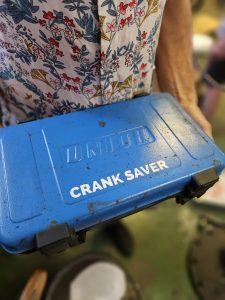 In the pre-Covid world, Nils Hansen from Woodstock Cycleworks ordered something called a Crank Saver Kit, made by a Slovenian tool company called Unior. It’s a box of cycling hardware that Hansen says he and only one other bike mechanic in the Western Cape have in their possession, and it’s made him the go-to man for crank alterations in the Cape Town area.
“I ordered it in 2018, and it took two years to get here!” he says. “The demand around the world was so high, and very few were coming into the country. I think Louis-Bresler Knipe and I are the only two people with these in the Cape. It means we’re the only people who can repair the threads on cranks – and manipulate them…”
Shortening a crank is relatively easy, but it’s pointless if you can’t tap a new thread. As Hansen explains, you need a drill press to drill the new hole, and then the Crank Saver to create a new thread for your pedal. “It’s the rethreading that’s the biggest challenge, because the drive-side crank is clockwise and the other side is anticlockwise,” he says. “You can’t use a hand drill. The thread itself is very bicycle-specific; you can’t go and buy this stuff in a hardware store.”
Hansen’s ‘crank era’ began with a parent’s request to shorten the cranks on an adult-size bike that his child was riding. “This client’s kid was using an extra-small Giant with 175mm cranks to do league races. I took 20-year-old 175mm cranks and threaded new pedal holes at 155mm – which made a lot of sense for the kid, because his leg extension was very minimal, and there’s a set gear range that juniors are allowed to use for races. He wasn’t going to push a 53 ring, in other words. I installed the new threads but I didn’t cut the crank, which gave him option of going back to 175mm in the future.”
For other clients, Hansen has lopped the ends off mountain bike cranks, mainly for “clearance issues”. With 165mm cranks, for example, you have far fewer pedal strikes than if you’re riding 175mm cranks, especially on a dual-suspension bike. In one case, Hansen did a modification for a shorter man with shorter legs, who also had pedal strike issues, so the shorter cranks were beneficial for both practical and biomechanical reasons.
A unique case involved a client who was involved in a microlight crash and almost lost his legs. “He’d had about 20 operations to save them,” Hansen recounts. “They managed to save his legs, but his knees were almost locked – his range of motion was so limited that he could only get about a five-degree bend. And the only way to pedal a bicycle with that range is to have very small cranks. In his case, I went to 140mm, on a triple-ring crank on a 26-inch bike. If you really want to feel what crank length does, get on a 26er with its full gear range, and make the cranks really short. It feels like you’re pedalling air!”
Personal choice
Shorter cranks come with trade-offs.
The most obvious one is less torque. Since torque equals force multiplied by crank length, shortening the crank requires the rider to push harder to generate the same force. For strong, well-trained riders with a smooth pedal stroke, this isn’t a deal-breaker. For weekend warriors and newer cyclists, however, it can feel like harder work – especially on climbs.
“Some elite riders have shifted to shorter cranks, for various reasons; but they have the freedom to experiment, and have advanced testing methods to assess if the changes work or not,” says coach Reece McDonald. “Personally, I don’t think every recreational rider should ride shorter cranks simply because some professionals do.
“Firstly, there’s a cost impact. Secondly, the evidence to show that changing your crank length makes a significant difference is limited to non-existent. We’re in the early stages. It’s an exciting area to watch, for sure; but more research needs to be done.”
McDonald continues: “Honestly, there’s no right or wrong answer. I use 172.5mm cranks, and they work best for me. But I will say this: if you’re a cyclist who suffers from tight hip flexors or hip impingement issues, or if you have short legs, then shorter cranks are worth considering… although the correct length is hard to define. If you’re comfortable with your fit and position, rather focus on other areas of improvement before exploring this option.”
McDonald suggests targeting traditional performance gains: “Do a proper bike fit, train correctly, sleep well, eat better, enjoy riding your bike. Those are the things that make a difference.”
For Hansen, it comes down to personal choice: “Customers get the impression that it makes a big difference for the average Joe – and I do have a feeling that people read too much into what elite riders are doing. I’ve been riding for 25 years, and I use all types of cranks – 175mm, 172.5mm, 170mm… I did the Cape Town Cycle Tour on a ‘mini-bike’ with 165mm cranks, so I’ve ridden them all. I can feel the difference at 165mm, but the rest hardly makes a difference to me – that’s coming from an average-height person with regular legs, though!”
The crank debate is now no longer about whether shorter cranks make sense; rather, it’s a discussion around when riders will get to explore the option. SRAM and Shimano start their crank ranges at 160mm, while Campagnolo’s Super Record Wireless starts at 165mm. That said, Nils Hansen and David George – both bike-shop owners – caution that you’ll struggle to get those shorter lengths in South Africa any time soon.
Like most things in cycling, shorter cranks might simply come down to what makes sense to you. George believes that 165mm will start to become the norm at events like the Tour de France, “and I’m willing to bet that SRAM will be producing 155mm cranks by the end of the year…”
Watch this space.
The evolution of a crankset
The first Dura-Ace groupset was launched in 1973. It was aimed at professional and keen amateur road cyclists by a then-lesser-known Japanese company, in a market dominated by European brands such as Campagnolo.
The ‘Dura’ apparently comes from ‘duralumin’ (the aluminium alloy used to make the first edition) and ‘durability’. And the ‘ace’ part? Well, let’s just remember that Shimano is Japanese.
Shimano Dura-Ace has been used by countless pro cycling teams and champions over the years. It’s the groupset of choice for current world champ Tadej Pogačar.
 1970s
1970s
Dura-Ace GA-200
Early Dura-Ace offered indexed shifting and a lightweight design, but struggled for immediate acceptance in European pro racing circles.
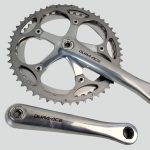 1990s
1990s
Dura-Ace 7700
In the 1990s, Dura-Ace added STI (Shimano Total Integration) – combining brake and shift levers into one unit. This was a major move in road-bike design and ergonomics.
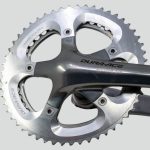 2000s
2000s
Dura-Ace 7800
This series introduced 10-speed drivetrains and widespread use of hollow-tech cranks and external bottom brackets, boosting stiffness and power transfer.
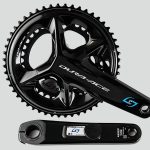 Modern era
Dura-Ace FC-R9200
R9200 is the first Dura-Ace 12-speed groupset. And for the first time, the cranks are offered in lengths of 160mm, 165mm and 167.5mm – along with the standard longer lengths.
READ MORE ON: Cranks cycling trends tech tech talk trends