Inside UAE Team Emirates: SA Dr Jeroen Swart’s Winning Formula
South African coaches and Sports Scientists are globally respected for their expertise. And Dr Jeroen Swart is among the best. Here's how he's helped make UAE Team Emirates the Number One team in the world.
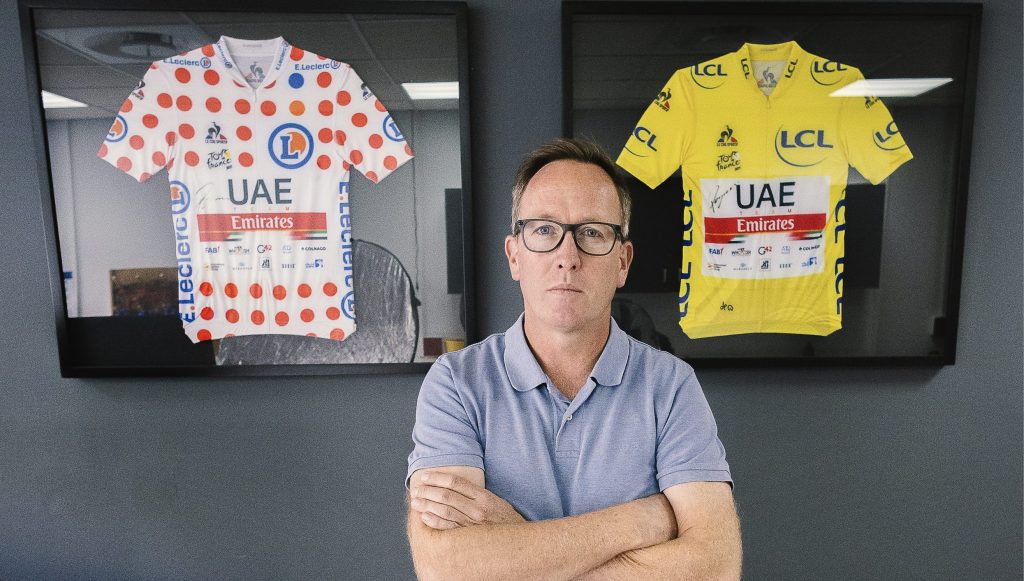
Tadej Pogačar, Adam Yates, Matt Beers, Chris Froome, and indeed anyone who has benefited from the training programmes of Science to Sport… you all owe Kevin Costner a thank you. It was his role as sports physician Marcus Sommers in the iconic cycling movie American Flyers – plus watching the Tour de France every year – that inspired Jeroen Swart to become a sports scientist.
“Everything I’ve done has led to this moment.”
“In my head, I wanted to win the Tour de France – and I also wanted to be the guy that Kevin Costner was in the movie, the guy who knew everything about sport,” says Swart. “I was 11 at the time; and now, holy sh*t, nearly 40 years later, everything I’ve done has led to this moment.”
What does the role ‘Head of Performance’ at UAE Team Emirates actually entail? When I joined the team in 2019, we were 16th in the world. At that point, there were clear gaps that I started plugging, looking at things like biomechanics, nutrition, load monitoring and so on. I did a lot of the work myself, but my actual role when they hired me was to find people who were at the cutting edge. My job was to recruit them, manage them, and ensure we could deliver the absolute best.
What was the vision for UAE when you joined? We wanted to be the number-one team in the world. And we wanted to win the Tour de France, which we managed to do within two years, when Tadej Pogačar won in 2020.
It was marginal in 2020, more convincing in 2021, and by 2023 we were the best team in the world. That was five years on from the team camp where we outlined our goals.

Fans see the riders racing and winning, but a team is more than that. Tell us what goes on behind the scenes. It’s a huge team effort. We have more than 100 staff. Like any big organisation, it’s a collective effort that starts with a management structure, and goes down to every person who has a role to play in day-to-day activities.
My day-to-day activity is to manage the coaching staff, implement the team philosophy and methods, organise the training camps, test riders, oversee the development of our data platform and engage with the team about nutrition and equipment.
Our Team Principal and CEO, Mauro Gianetti, lets us do our work. He doesn’t micromanage. I think that’s what’s happened at some other teams… Micromanagement doesn’t work – you have to trust your team, and let people get on with it.
What does ‘performance’ mean to you? There are two questions here: ‘What is performance?’ and ‘What does performance amount to?’ What it amounts to is us winning races and scoring points. What goes into it is a broad-based multidisciplinary environment, where all aspects are addressed.
I think a key part of that is knowing where to spend your time and effort. A lot of teams go wrong when they follow the latest trend or idea, and they invest heavily in that trend, but it doesn’t really move the needle. So, knowing where to apply your energy and getting the maximum return is a huge part of performance. The same is true in cycling, Formula 1, and indeed in any business.
Okay, so how do you move the needle? This is where my role as a generalist comes to the fore. For instance, you can have someone who knows everything about genetic sequencing technology, they’re a leading expert in that field, but outside of it, they know very little. Generalists are people who know a lot about a lot, but they don’t know everything about anything.
“You could use the analogy of an orchestra conductor – I make sure everybody is playing their part. “
Being a generalist allows me to identify the experts in each field and work out how they could fit into the overall puzzle. You could use the analogy of an orchestra conductor – I make sure everybody is playing their part.
So, you’re looking into everything at all times? Basically, yes. When it comes to nutrition, for example, I help our nutrition sponsor, Enervit, develop the right products in line with the latest science, and ensure that the products are palatable and that the riders actually like them. Then there’s the macro-nutrient part – the meals – where we have three chefs who prepare our meal plans at all our races and training camps.
At an equipment level, it’s looking at different wheels from Enve and tyres from Continental, and deciding which tyre on which rim at which pressure is the right combination to maximise performance. Then it’s looking at what’s most aero, rolling resistance on various surfaces, weight and rotational inertia – and where a particular stage or race fits into that picture.
We do all these things on a daily basis. There’s a lot of coordination; a lot of communication.

Wow, that’s a dizzying amount of detail. How do you avoid analysis paralysis? You have to be honest. A coach might think we should do something, for example. It might be a good idea, or an interesting idea, but my role is to decide whether that idea fits into the overall plan, and whether we have the time and resources to implement it. It’s a layering process.
It’s impossible to know everything and implement everything. Every year you understand what works, and you learn that a philosophy that might have seemed attractive isn’t working; so you discard it, and you keep the things that do work.
We have protocols, and they become so embedded that they become second nature, and only then do we layer on something new. Layer upon layer; and then, one day, you end up with the most beautiful cake.
Is it ‘Tour de France’ and then everything else, or do you look at every race in the calendar? The calendar is super-important. Our Sports Manager, Matxin Joxean Fernandez, looks at the calendar with the other directors and coaches, and decides which riders will go to which races based on what we see as the optimal way to win them.
You have to look at the other teams, too – we might choose to send a second-string team to a race because we know Alpecin is going to come with Jasper Philipson and win that race. We’re not going to invest our best riders where they’ll likely finish fourth or fifth; we’d rather send them to another race where they’re going to win.
How important is the Tour de France, then? It’s the biggest race in the world, with the most exposure. It’s also the most important for the sponsors. But as a team, we’ve moved beyond only looking at the Tour.
A decade ago, Team Sky… They were all about the Tour. Or Grand Tours, I should say. They seldom featured anywhere else. Our approach is to win throughout the season, from the Tour Down Under to the final races of the year, like the Tour of Guangxi.

Does it make your life easier or harder when you’re working with an athlete of Tadej Pogačar’s ability? We’re very lucky with Tadej. Not only is he incredibly gifted physically, he’s also incredibly strong mentally and emotionally – he’s the best kind of rider to have in a team. He’s engaging, with staff and other riders. He’s demanding, but he’s never a prima donna. He’s level-headed and down to earth.
As an example, he doesn’t feel he should have better equipment than anyone else. If we present him with a lighter version of a frame, his first question is, “When are the other riders getting this frame?” That motivates everyone. When it comes to tactics, he never expects everyone to just help him win races – he wants other riders to win, too. He encourages the other riders.
What about the other riders – how do you manage everyone’s egos, when everyone wants to win? It’s a team effort, and it’s something we work on all the time. It’s not just about selecting riders based on performance – we’ve seen the detrimental effects of that. Instead, we have a similar selection policy to the All Blacks’ ‘no dickheads’ policy. We screen riders’ personalities to ensure that the athletes coming in will elevate the status of the whole team, instead of just going by performance.
Again, communication is so important. We might have a discussion with a rider and say, “Your role will be to support Tadej at the Tour de France, but there will be other opportunities along the way – at the Giro or the Vuelta.” If you’re a rider at another team, you know that Tadej is probably going to the Tour; so you can join our team and be part of that success, or you can go elsewhere and roll the dice.
Look, it’s not all about Tadej. Last year we won 81 races – Tadej won 25 of those. It was the greatest number of riders winning races in the history of the sport. We had around 20 different winning riders.
Is having such a dominant team like UAE good or bad for the sport? If you’re the top dog, people are always going to want to see you fail. They’ll always root for the underdog. Still, I think the way that we win – and the panache of riders like Tadej – means that people enjoy watching us.
Look at Milan-San Remo – the way we rode it this year was very exciting. Everyone knew our plan, and it was up to the likes of Mathieu van der Poel to deal with our tactics and win the race, which he did. But our tactics created huge excitement, which you wouldn’t have without us.
If you go back to the days of Sky, people hated that. That was boring racing – seven guys in a row, peeling off one by one, with one guy eventually moving to the front. Grand Tours since 2020 have been very exciting.
So, yes, winning too much does annoy a certain percentage of the crowd, and it makes people root for your rivals. It’s the way we win that makes the racing exciting.
Do you think your success is forcing other teams to raise their standards? Jayco-AlUla, Lidl-Trek and others – they’re all recruiting the right people and pushing hard.
For example, there’s always a stage now in the Grand Tours – usually in the final week – that scares us. It’s usually stage 18 or 19, the last big mountain stage; and it’s attack, attack, attack, from the word go. A group of 20 will go that contains four or five guys who are a threat to the GC. They’ll build up a lead of eight or nine minutes, which causes chaos in the race.
But I digress… The answer is ‘yes’ – the other teams are definitely lifting their game!
What’s more important – the science or the talent? You need both. There are lots of riders with phenomenal talent. Thibaut Pinot, for example, is one of the most talented riders of his generation; but he never won any major races.
The French approach of panache over all else… There’s no room for that. If you bring that approach, you will lose. If you don’t apply the science, you will lose. With the amount of talent in the World Tour, you’re not going to win on talent alone. You have to have both.

Where to from here, in terms of performance? How much further can you push the human body? We’re still some way from the ultimate. Every year we think, ‘Oh, jeez. Our guys are not going to get any faster.’ But then we make some changes, and they do get faster.
Tadej is a great example. In the winter of 2023, we asked, ‘Where are the gaps in his performance?’ At the time, he’d come second at the Tour de France and he was ranked the number-one cyclist in the world. But we still asked, ‘How can he improve?’ We identified three or four areas where he might improve by a percent. We implemented the changes, and on some metrics we’ve seen a six-, seven-, eight-percent improvement. That was a surprise. You think you’re at the limit, but you don’t actually know where the limit is.
That said, there’s been a paradigm shift in cycling, and the areas for improvement are getting smaller. Back in the day, Team Sky had a scientific approach, but they didn’t have a scientific approach – if that makes sense. Their marginal gains approach still had massive gaps. We’ve found most of those gaps, and we keep finding new ones. But they’re getting harder to find!
So, where are the gains going to come from in the future? The UCI keeps changing things, especially when it comes to bike design. Last year, there were changes to the overall dimensions – maximum length relative to width. That’s what resulted in the dramatic design of our new aero bike. So, as regulations change, there’s a lot of scope for technical innovation.
If you ride a bike from a decade ago and you compare it to the current bike, you can feel the difference. And if a ‘normal’ rider like me can feel the difference, can you imagine what it’s doing for the pros? It’s like going from a gravel bike to a road bike – the difference between our bike in 2020 and our bike in 2025 on a climb like the Col de la Madone is about two, two and a half minutes.
What about the riders themselves – can they do more? Physically, some areas are topping out. Like nutrition – we used to think that the maximum gut absorption rate for monosaccharides or sugars was 80g an hour; now we’re seeing evidence emerging that it’s around 110g per hour.
That’s one of the reasons the guys are going so fast from the gun, and producing performances on the final climb that are mind-blowing: a large part of it has to do with nutrition. When we started in 2019, we were doing 40- to 60g, and pushing the guys to do 80g at key moments in the stage. Now it’s 110g from the start, and boom.
Last year, after lots of research, we introduced heat training, which gave our riders another massive performance gain. If we see similar innovations coming, there’s always scope to push things further.
What’s been the biggest change you’ve seen in terms of performance since being involved with UAE? The main thing is monitoring the riders and stopping them from training too hard. They were missing that optimal cycle between training and recovery, adaptation, and improving. Many of them weren’t improving; and some were even going backwards, because they were getting progressively fatigued throughout the season. Monitoring the riders has been massive.
The equipment changes have been massive, too. There’s probably about a dozen different elements that have changed.
Has cycling moved beyond the ‘Armstrong Era’? Is the racing clean? Absolutely. The problem is that you can never prove a negative. But being embedded with the riders and the staff, there’s a complete change in the whole ethos. I haven’t seen anything that has given me pause in the seven years I’ve been on the World Tour.
“I can only speak for ourselves, though, and cheating can happen in every facet of life. But from a cultural perspective, there’s been a massive change in the sport and we want to keep it that way.” *
I wouldn’t risk my reputation just to win races. My reputation is everything to me – I wouldn’t have joined the team if I didn’t think the culture had changed completely.
Do the riders ever bring up that era of racing? We ignore that era. Most of them don’t really talk about it. Occasionally, there’s the odd joke about it, but it’s not something we actively discuss. We just accept that the culture has changed, and that it’s a new era of racing.
Why do South Africans seem to excel at sports science? Cycling is very popular in South Africa, thanks to prestige races like the Cape Epic, which put us on the global stage and motivated world-class riders like Burry Stander, Alan Hatherly, Kim le Court, Matt Beers…
My partners and I started Science to Sport in 2008 – it’s our global business that provides high-performance services around the world to pros and amateurs. We don’t just measure things because they exist – we look at all the tests on offer and see if people have been doing them wrong.
In bike fitting, for example, why are we using a plumb line? We threw it out, because there was no evidence to support its effectiveness. We look at the science and make it accessible to the athlete – something they can use to make a real difference in their performance.
Fast forward to 2025 and we have seven partners and 10 associates, and we operate on three continents and in many different countries. We’re recognised as globally leading experts. When Specialized Factory Racing needed a Head of Performance, they came to us. We put Mike Posthumus forward, and he’s made them the number-one team in the world.
It’s been a long and eventful journey, and here we are.
- Edited on 27 July for clarity
READ MORE ON: interview pro cycling UAE Team Emirates