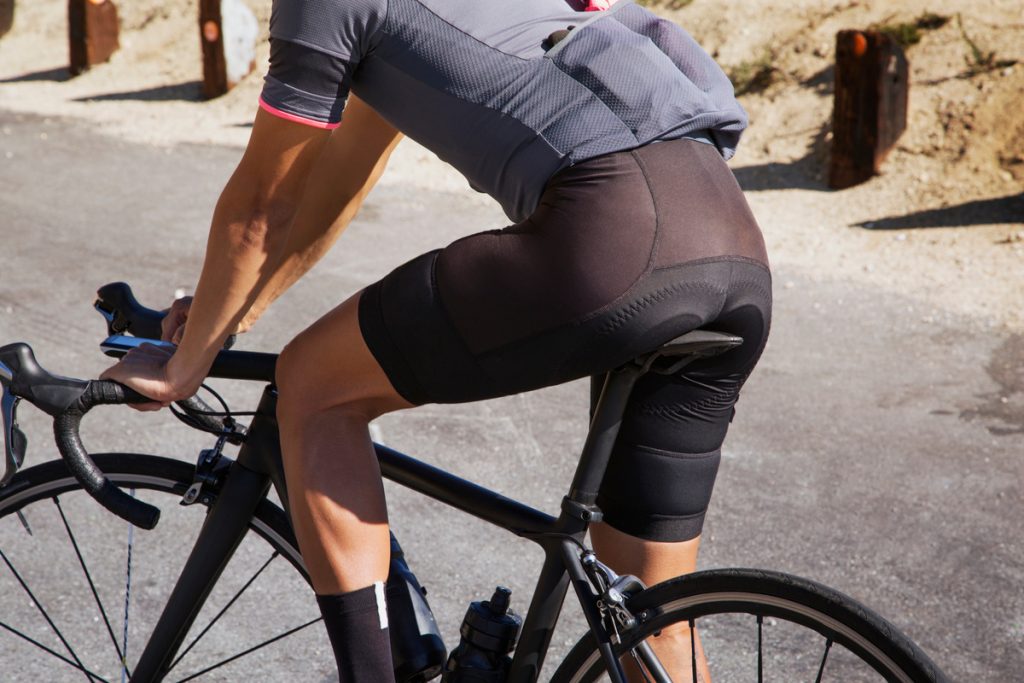
Is more “padding” more comfortable?
I know there may be riders who’ll argue this point, but my answer is a resounding, “No.” More “padding” from a thicker chamois means opportunity for more bunching, more chafing, more compression of soft tissue, and more feeling like you’re walking around with “diaper butt.”
More often than not, if a rider is trying to solve saddle discomfort by loading up on a thicker chamois, the problem is the saddle, not the shorts. Getting a saddle fitting and finding the right style and shape for your body and your riding position, and making sure it’s set at the right height, would be a better place to start addressing the issue. If you’re riding the wrong saddle set at the wrong height, it ultimately won’t matter what you’re wearing; you’ll still be uncomfortable. Even the best pair of bibs won’t fix a bad bike fit.
Should I change out of my bike shorts after a ride?
Yes! Tight, damp bike shorts keep sweat, heat, friction, and bacteria close to your skin, which can irritate hair follicles and increase your risk of chafing, folliculitis, yeast infections, and infected saddle sores. Dermatologists specifically recommend changing out of tight workout clothes like cycling shorts and showering after getting sweaty to help prevent those kinds of skin problems. What starts as simple chafing can progress into issues no one wants to deal with if the skin gets damaged enough and you keep sitting around in sweaty shorts.
Do “good” shorts have to be expensive?
Not necessarily. It really comes down to finding a pair that fits your body and your specific anatomy. While the quality of the chamois, fit, and fabrics are generally higher the higher you go in price point, that doesn’t always translate into a better-fitting garment for you specifically. I’ve had the experience of testing a top-end pair of bibs and being miserable, while being so comfortable I forget I’m wearing a chamois at all in the mid-high range model from a different brand.
Should I use chamois cream?
In my experience, the answer is most likely yes, with some caveats. Chamois cream is another thing that’s a matter of personal preference and what works for you as an individual. Some riders need to use it on every ride or they’ll end up uncomfortably chafed; other riders never have to use it at all. For me, I’ve found that it’s often ride-length dependent; shorter rides in bibs with a super comfortable chamois with minimal padding are usually fine without chamois cream in a pinch.
But again, this is about dialing in what works for you. I tried about half a dozen brands of chamois cream over the years, and I found the one that works best for me, isn’t super greasy and feels more like a heavy moisturiser that protects my skin. In my experience, if you’re having to use half a tube of chamois cream to make yourself comfortable and prevent a pair of bibs from causing chafing, the problem is probably the shorts themselves.
Ultimately, cycling shorts are supposed to make riding more comfortable, not give you one more thing to overthink. They should have a snug fit, stay put, manage moisture, and reduce friction. If they’re doing their job, you honestly shouldn’t be thinking about them much once you’re on the bike.
If a pair is digging in, bunching up, trapping sweat, or leaving you chafed and irritated after every ride, that’s not something to tough out; it’s a sign that something is off that needs adjusting. Whether that’s the shorts, the saddle, or your overall bike fit, find what works for your body, change out of your kit when you’re done, and remember that the goal here is to find what’s comfortable for you.