
Chasing the World Cup Dream — Jason Boulle’s Leap into Enduro
To live his enduro World Cup dreams, Jason Boulle packed his wife, his bike and his work into a Ford Transit van for an eye-opening journey across Europe.

Jason Boulle knew he had to leave the comforts of home and hit the road if he hoped to achieve his dream of racing enduro at the highest level. Aided and abetted by his wife Leslie, the 2024 South African enduro champ did exactly that – he took a leap of faith. (Sometimes literally, when negotiating tricky descents!)
“We spent three months living in a van, chasing a dream and racing the best in the world.”
Jason and Leslie learned bits of multiple languages on the hoof, cooked out the back of their van, worked (remotely), and pieced together a season of flat-out racing at the UCI Enduro World Cup – all while fending off the Mighty Euro with only the Plucky Rand. They spent just over three months living in their van, taking the roads less travelled, munching pain au chocolat, and mixing it up with the world’s best racers.
Determined to step onto a World Cup podium, Boulle is currently back in South Africa, plotting, planning and maybe even dreaming about his “comfy” bed in the back of the Ford Transit, which he’s parked in Vienna for the off-season.
Of all the blossoming cycling disciplines, why enduro?
I’m not the kind of person who enjoys suffering on a bike. I’ll climb, sure – as long as there’s a good descent on the other side!
My competitive streak has always been activated by the technical side of riding. In high school, I started following the Enduro World Series (as it was known then) online; the locations were so beautiful, and it just looked really adventurous. I loved the spectacle of downhill racing; but watching these enduro guys do 50- to 60km days and lugging their bikes up mountains, carrying spares and food… it really appealed to me.
What the heck is enduro?
Enduro racing is a mountain-biking discipline in which you ride a challenging route – but you’re only timed on the downhill segments, not the uphill sections. It blends the speed of downhill with the endurance of cross-country, rewarding fitness, consistency and composure across the course.
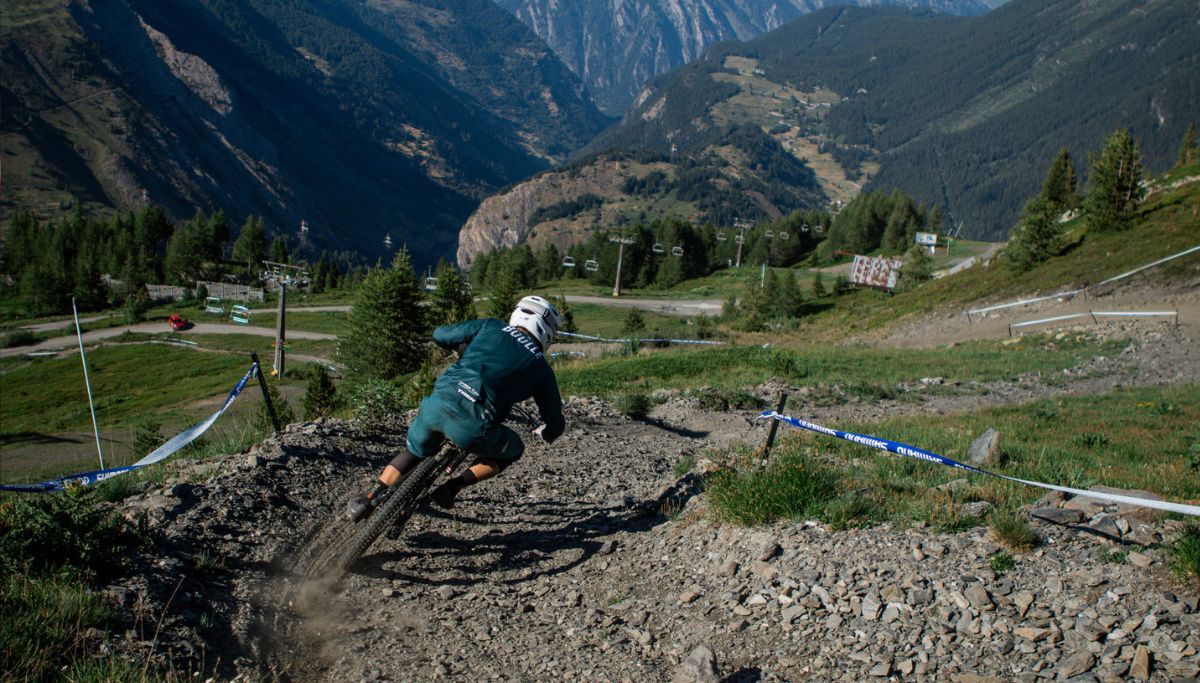 La Thuile, Round 6, Italian Alps
Explain how enduro differs from downhill?
Downhill has the history and the spectacle – it’s been going since the 1990s. The Enduro World Series has only been going since 2013 or 2014, and then only became the UCI Enduro World Cup a few years ago. At this stage, enduro doesn’t have a long history.
In downhill, the jumps are bigger, the speeds are higher, and the routes are far more technical. That can happen because riders are allowed to practise on the track up to eight times before they race.
With enduro, the appeal is that you get to cover a variety of trails that most of the riders probably haven’t seen before. Enduro favours the rider who is consistent over the course of the day. The speeds are not as high as downhill, so you don’t get the same wow factor, but what you do get are the stories – riders having mechanicals, tyres blowing out, and comebacks seemingly from nowhere, after being completely out of it.
Has enduro been a constant in your cycling life, then?
Not really. Growing up, bikes were for fun. I wasn’t competitive in anything. I enjoyed the technical side of riding, doing wheelies and bunny hops and looking for technical terrain. I always enjoyed that aspect of cycling the most. I was more into paddling in high school, but I did a few stage races with my dad.
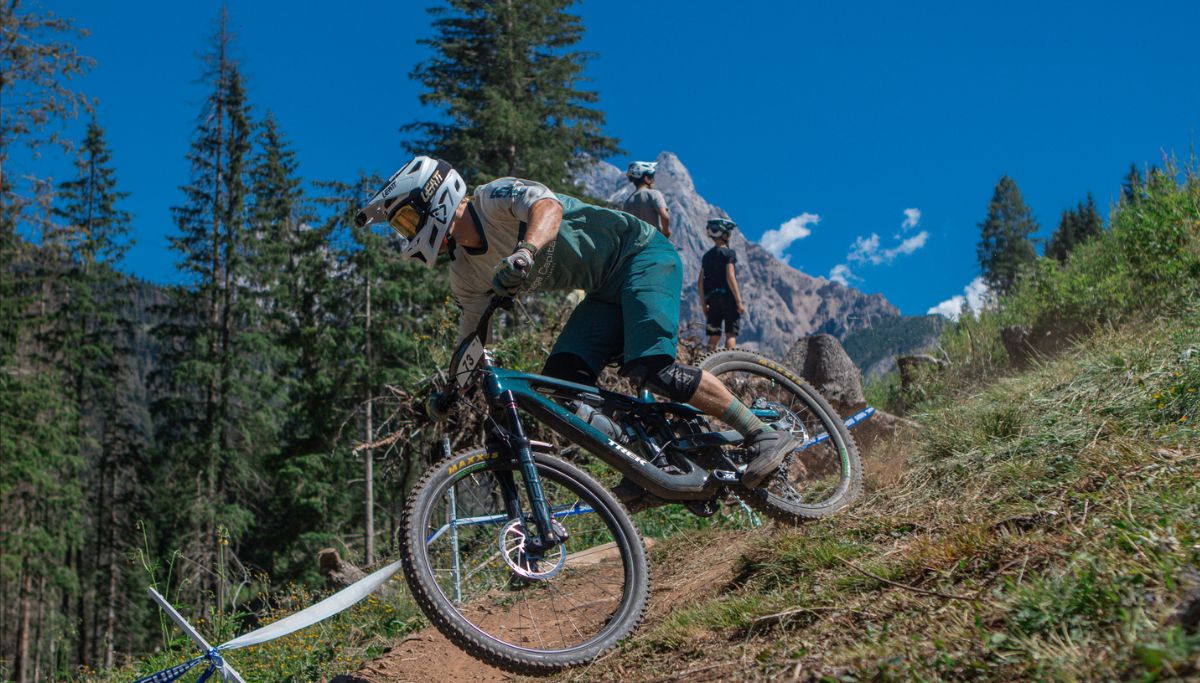 Round 5, Italian Dolomites
Where did the racing spark come from?
I was at Berg & Bush with my dad, and Pyga had some demo bikes at the event. I hopped onto the Pascoe – their trail bike, with 140mm of travel – and I was hooked immediately. Until then, I’d been riding my dad’s old Specialized Epic, with a seat post that was fused a centimetre too high for me.
The Pascoe changed everything. I made a deal with my dad that if I passed matric (not a given!) then he’d buy me a full-suspension bike – something he maintained was only for a person with a bad back!
I eventually moved to Cape Town, and started taking part in local enduro events while studying at UCT.
What was the Boulle masterplan, after getting a taste for enduro adrenaline?
I got a taste for international racing in 2019, when I did the Kingdom Enduro – three days of racing in Lesotho. It was wild, crazy stuff, carrying bikes up trails – or no trails, just a goat track. At some points, you were riding by feel, hoping that the trail was going in the right direction. But it was a blast, and I loved it.
Through that, I managed to qualify to race the Enduro World Series. Back then, it was still independent of the UCI. I had a trip planned with my dad for my 21st, and the timeline worked out perfectly. I very naively entered two races, one in the Italian Dolomites and the other in the French Alps. I had very little idea what I was doing. But again, I loved it, and planned to race more in 2020…
And then Covid came. Yup! But it wasn’t all bad. I finished my degree and started working.
I did the odd race when I could, racing guys like Matt Lombardi and Keira Duncan. I podiumed a few times; but back then, I wasn’t convinced I could beat them. I was just stoked to be racing and laying down some good results. I think that gave me some impetus to think about racing overseas again.
But I realised I wasn’t getting any younger; so I had a long chat with Leslie, and she was the one who encouraged me to give it a full go. I got a coach – Reece McDonald, at Science2Sport – and did some serious training. I raced some cross-country, some downhill, anything.
In 2023, I raced a full enduro season; then in 2024, I raced a full season again. The Insect Science Marathon team got on board to support me locally while I was doing their media work behind the scenes. I won two or three of the SA cups, and then the National Champs at the end of the year.
How big was the step up from local racing to the Enduro World Cup races?
It’s so different, on so many levels – the competition, the technical terrain, the stages, the physicality required, the big days of riding… It’s almost a different sport!
Locally, you’re maybe riding 20 or 30km, with 12 minutes of racing in total. In Europe, we were riding around 60km, or seven hours, with 12-minute race segments. I had to up my training considerably; I had to get fit for the big days of riding, but also have the energy to put max power down over the course of the day.
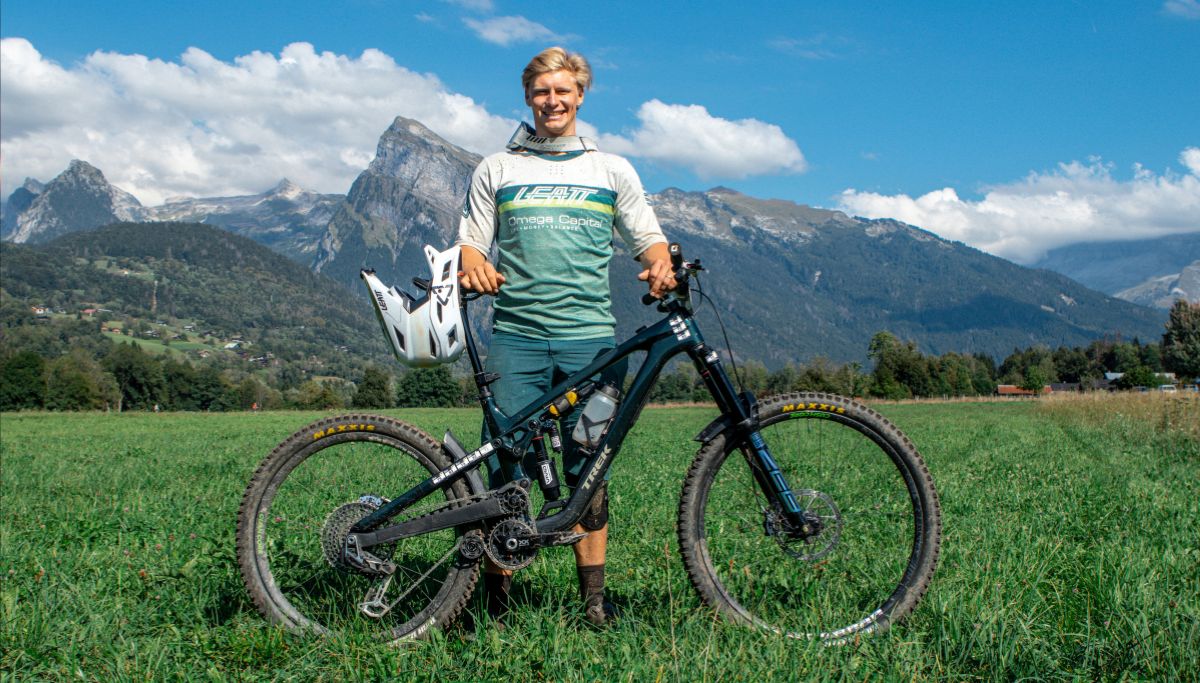 Jason with his Trek Slash in the French Alps
What are you riding on your Euro adventures?
I’ve been very fortunate to have support from Trek South Africa. They’ve helped me a great deal. I race on a Trek Slash, with 170mm of travel front and back – it’s an absolute beast of a machine.
At home in South Africa, I also have a Trek e-bike that helps me get in more practice laps without wearing myself out. If I have 90 minutes to do skills work, the e-bike allows me to get 20 laps in, rather than just a handful. I only took the race bike to Europe this year; next year I’d like to try and get the e-bike there too, so I can train more efficiently. It’s a great tool.
Maxxis has also been a great support, giving me as many tyres as I need. I also use CushCore inserts. Not everyone likes them; but as a heavy and direct rider, I appreciate the extra confidence, knowing I can ride into rocks with reckless abandon.
I use Maurten nutrition; because, as you can imagine, you eat quite a lot in seven hours on the bike. Omega Capital joined me as a financial sponsor, which was a huge help.
Is there a rider you look up to? Someone who motivates you to keep pushing?
Candice Lill has been a big inspiration for me – just seeing how she’s plugged away over the years, and kept going when so many other riders (including myself) might have called it a day. But she’s persevered, and done so well.
She’s been a huge influence on me – showing what you can achieve with consistent hard work.
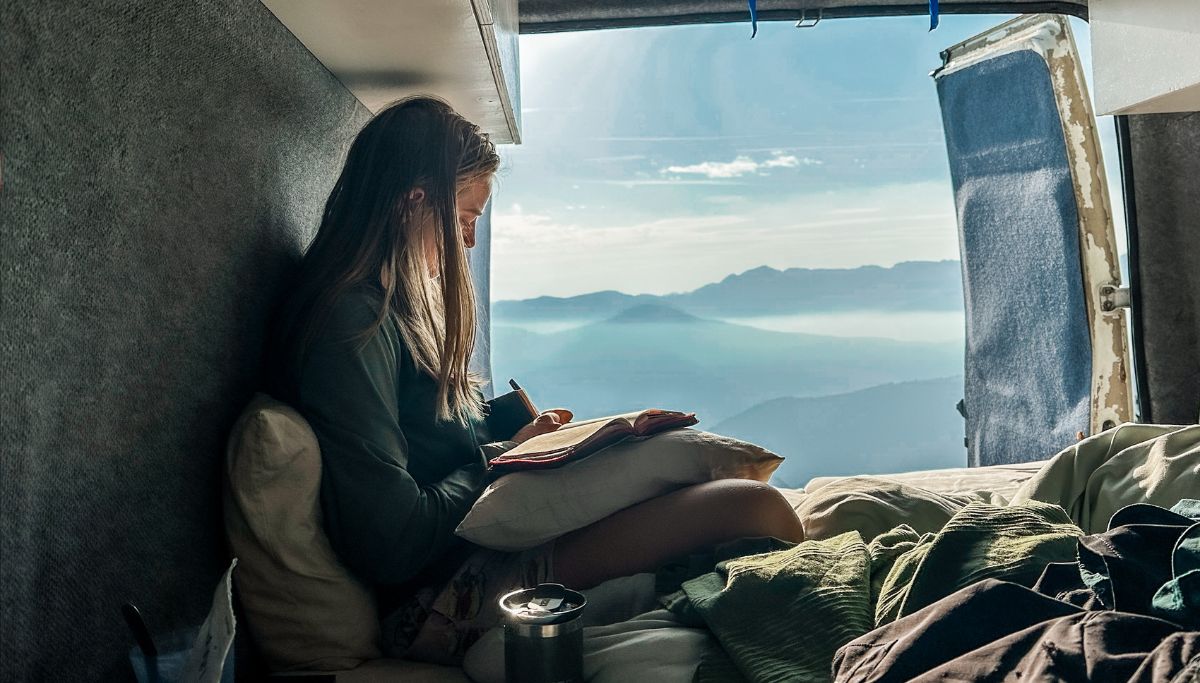 Pyranees, Leslie, and their comfy bed
Living in a van with Leslie – that must create some ‘unique’ moments?
It’s less stressful (and more cost-effective) than trying to book accommodation and transport all the time. But yes, also more challenging!
You have all your normal comforts stripped away, apart from a comfy bed, which the previous owners had installed in the van – at least the bed was nice and big and comfortable. We eventually caved and got a duvet, rather than the little throw we’d been using. That was our one luxury: a duvet. It was much needed in the Pyrenees!
Also, it was an incredible experience to live simply for a few weeks; it teaches you what you actually need, and what’s unnecessary.
What were some of the van-life challenges you faced?
Europe caters pretty well to a camper van lifestyle; but you have to pay for parking at most places. Even if you stay in campsites, the overnight fees can easily add up to R20 000 a month, so we always did our best to look for free parking. There was usually enough.
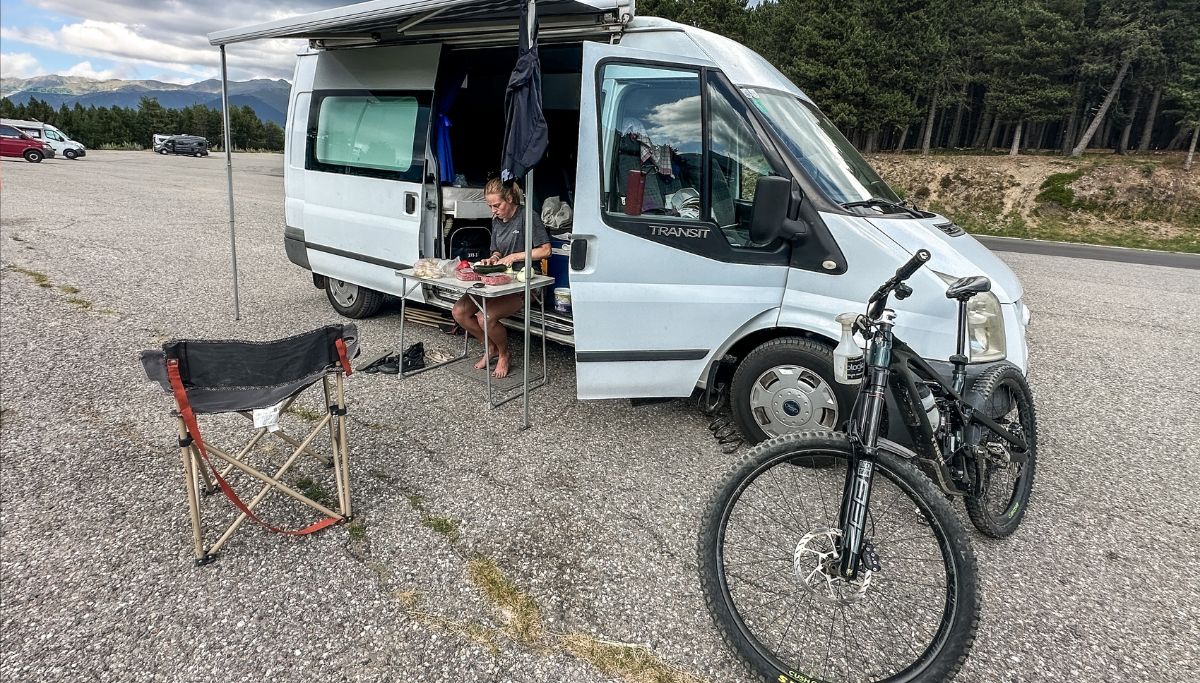 Free parking at the bike park in Andorra.
That said, the van wasn’t kitted out for off-grid living. There was no back-up battery or water system; we used five-litre water jugs to wash and cook with. We used a gas cooker for meals, and parked strategically near restaurants that had bathrooms.
Often we’d have to wait until 9am, when the bathroom opened; but sometimes 9am was too far in the future, which necessitated a quick walk into the bush… I think the hikers in the Pyrenees are quite happy we’re not there at the moment!
Avoiding tolls was a big cost-cutter, but we came to enjoy that. On our first few drives, we paid for the tolls because that’s what we do at home; you don’t even think about going on the toll-free roads. But it adds up very quickly – £200 in tolls on one trip is pretty harrowing.
One day, we decided: that’s it – no more tolls. Taking the district roads turned out to be amazing. We saw some beautiful towns and countryside that we’d never have seen otherwise. We pulled over at crystal-clear lakes, swam, and spent evenings with other campers.
How did the relationship handle the travelling, the van, and the toilet breaks?
There was definitely a bit of trauma bonding – finances are already stressful enough in a relationship. The rest was also tough. Constantly moving around, new towns, new malls, new places; not having your usual support network around you, when things get challenging… But we’re both grateful to have gone through it together.
Thankfully, when things got really tough, there always seemed to be a well-timed break or intervention that appeared: a friend who invited us to stay for a few days, or someone offering to make dinner for the group. That kind of thing.
And the language barrier?
The hardest part was trying to remember which greeting to use, depending on where we were! But language isn’t really an issue in Europe, as long as you try to say hello in the local language.
We had one amusing moment when we pulled into a small Italian town, hoping to get some rubber seals on the van’s back doors replaced. We found a local auto repair shop; but the man on duty spoke no English, and we spoke no Italian – especially relating to this very specific problem. There were lots of hand gestures, some Google Translate, and an outcome where – after he put his instructions into Google Translate – it left us needing to purchase a ‘blue peacock’ to fix the car. I’ve been scratching my head over that one for months!
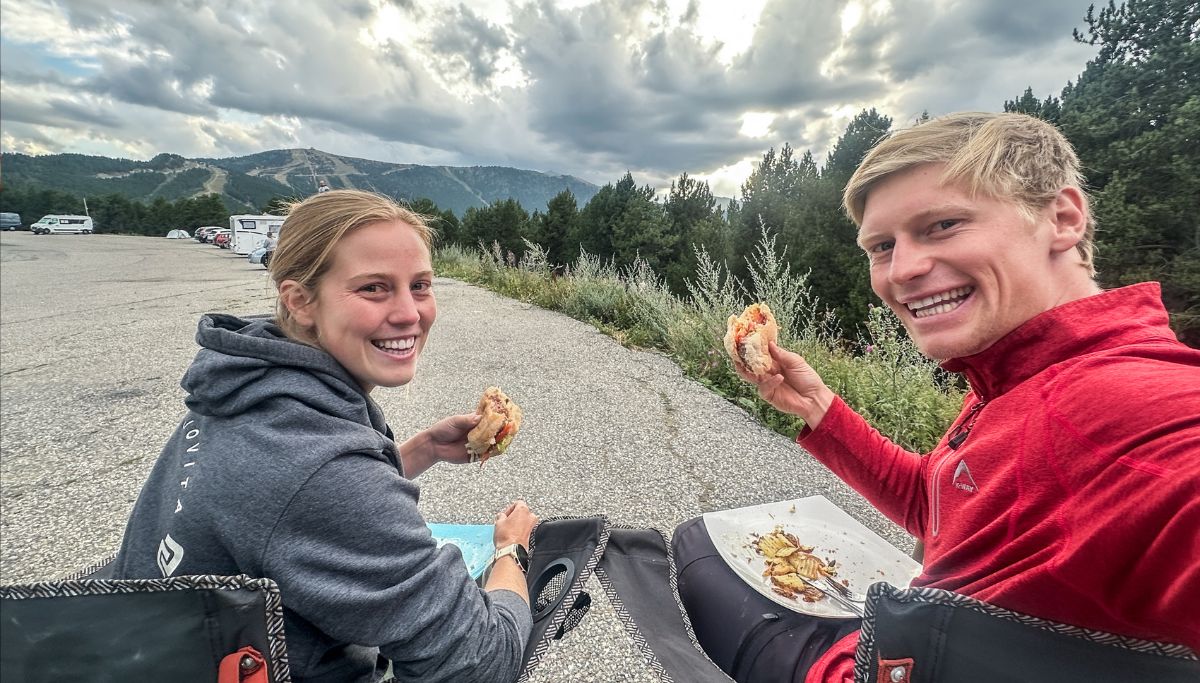 Dinner at the bike park in Andorra
What was a memorable moment that you took away from your trip?
Waking up in a quiet parking lot in the Pyrenees, in Andorra, just Les and me, beautiful views over the mountains, oats for breakfast – a simple existence, but so rich with experience.
By the numbers
- 126 Days away from home
- 11 000 Kilometres driven around Europe
- 8 Countries visited
- 7 World Cup races
- 49 Total number of stages
- 4hr39 Total race time
- 190+ Hours on the bike
- 60 000m Total elevation descended
- 1 100+ Kilometres ridden
- ±60 Nights in the van