
7x Reasons to Ride 1x On Your Road Bike
Ditching the front derailleur is gaining popularity among road cyclists. Here’s what you need to know about the 1x drivetrain trend – and whether it’s right for your next upgrade.

The all-in-one climbing/aero bike was probably the biggest gear story of the 2025 Tour de France, but there were many other interesting equipment choices that also caught our attention.
1x on a road machine is also less crazy than you might think.
If you looked closely, you might have noticed some riders had skipped a front derailleur, using a 1x drivetrain. And not just on flat stages: 1x drivetrains were used even on the toughest climbing days.
Non-pro riders like us should be cautious about making equipment choices based solely on what the pros are using – we’re not as fast as they are, and we don’t have a convoy of cars following us to handle the issues that might crop up. But still, you might be wondering: why would someone choose 1x on a road bike? Do I want that?
These questions become even more relevant when you consider that the latest race bikes from big brands like Cervélo and Trek come with 1x drivetrains. Many other brands are likely to follow suit.
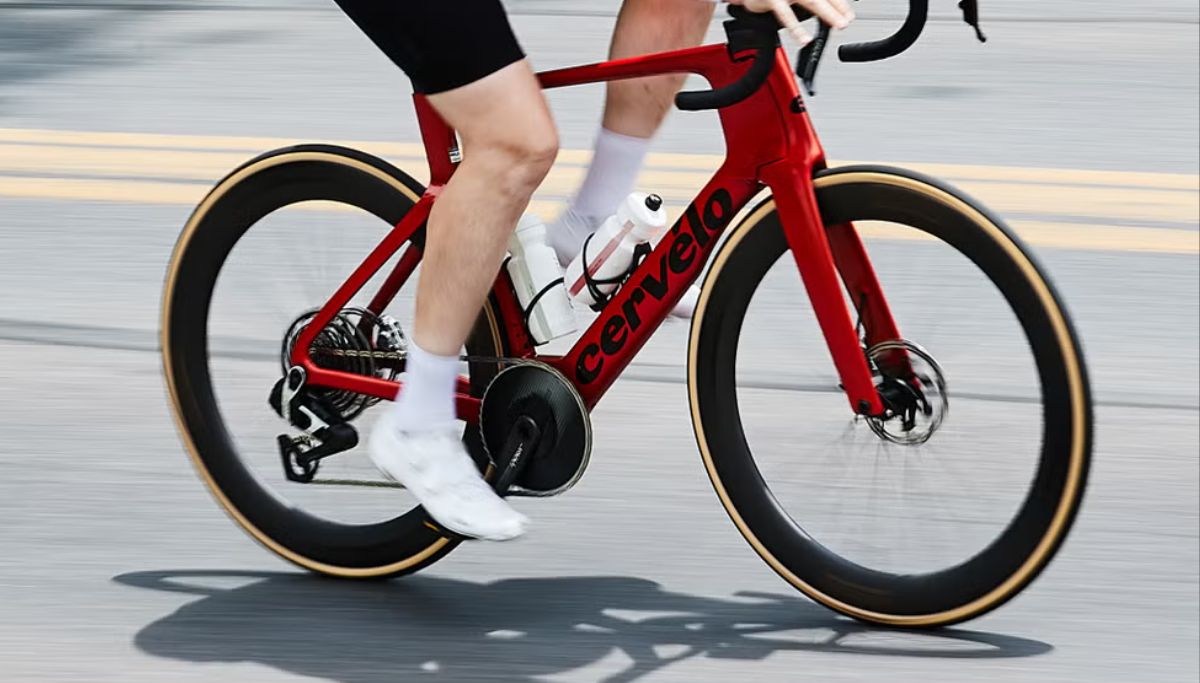
It might not be for everyone, but 1x on a road machine is also less crazy than you might think. Here’s why:
1. Simplicity
One of the best things about a 1x drivetrain is its simplicity. There’s only one shifter to deal with, and one derailleur. Shift one direction and pedalling gets harder; shift the other way and pedalling gets easier. A 1x drivetrain is easier to ride, easier to set up, and easier to maintain. And you don’t have to worry about cross-chaining.
2. More reliable shifting
Because of the size difference between the large and small chain rings, a front derailleur has to move the chain across a far greater vertical distance than a rear derailleur. Also, a front derailleur shift is initiated on the high-tension, top run of the chain, while a rear derailleur shift is started on the lower run of the chain, where tension is less.
Given these factors, if you’re going to have an issue with your drivetrain, it will most likely be up front. Two of the most common issues are sluggish or inconsistent shifting, and routinely dropping your chain. Ditching the front derailleur eliminates these issues.
3. Chain retention
Speaking about (not) dropping your chain… Most 1x road drivetrains borrow chain-retention technology from mountain bikes. The result is greater chain stability and security. Shifting is better on bumpy roads, and you’re unlikely ever to drop your chain. If you need even more security, you can easily add a chain keeper or chain guide.
4. Frame improvements
Removing the need to accommodate a front derailleur gives engineers more design freedom in a challenging part of the structure. Without the front derailleur to consider, there are fewer holes in the frame and more potential to create a stiffer design. A front derailleur can also limit tyre clearance, and it provides a place for mud and debris to gather in mucky conditions.
And although it’s not a functional improvement, 1x bikes just look better: faster, sleeker and cleaner.
5. Aerodynamics
This is not a major transformation, but removing the front derailleur does make the bike a bit more aerodynamic. We’re only talking about a few watts, but if you’re seeking to maximise your marginal gains, it’s another area to exploit.
6. Weight (maybe)
If you’re obsessive about the weight of your bike, 1x might be lighter than 2x; but not in all circumstances. It depends on how the bike is set up.
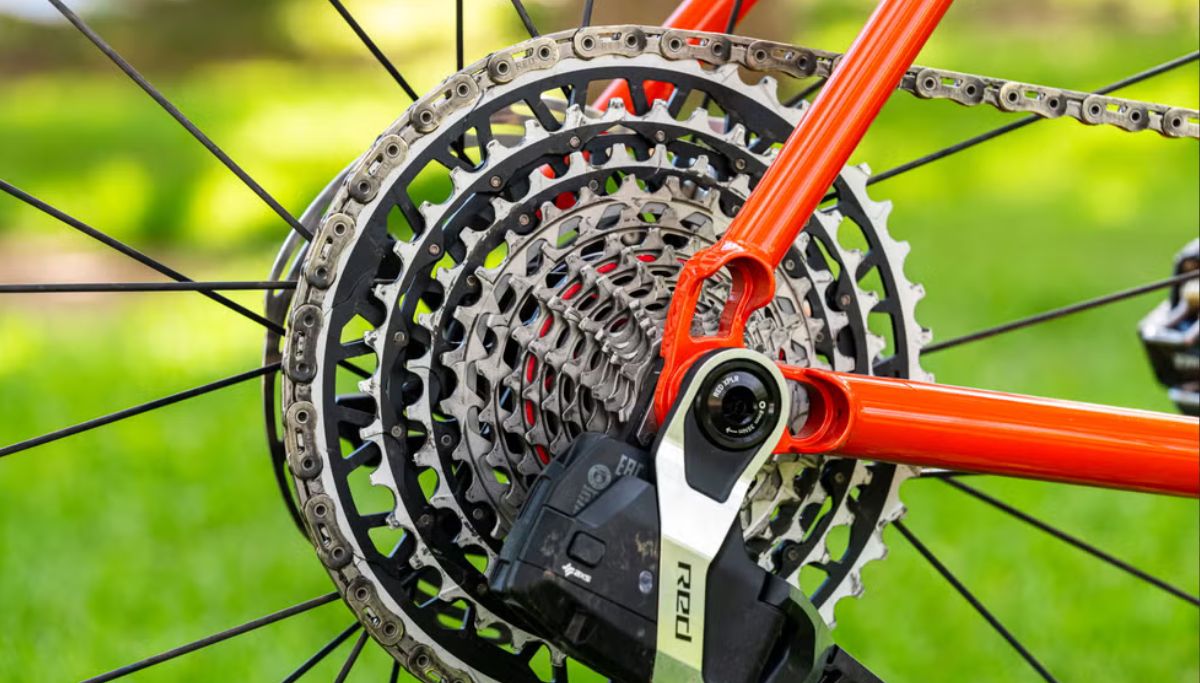
All else being equal, removing the front derailleur and one of the front chain rings will make a bike lighter, but keep in mind that you’ll need a wide-range cassette, which can be quite heavy, plus a long-cage rear derailleur to accommodate that cassette.
7. Similar gear ratios
Without getting too far down the maths rabbit hole and trying to cover every possible 1x and 2x gearing combination, I’ll simply say that a modern 1x drivetrain can offer a similar range to a 2x system.
Here’s an example: a 1x SRAM AXS XPLR 13-speed drivetrain with a 10-46t cassette and 48t chainring has a 460% range. That’s close to the 494% range of a SRAM AXS 2x drivetrain with a 10-36 cassette and 48/35 chainrings.
In this example, the easiest and hardest ratios of both drivetrains are also very similar, which means they have about the same climbing gear and spin out at about the same speed.
So, should I upgrade?
One of the main drawbacks to a 1x road drivetrain is that compared to a 2x road drivetrain, it has bigger jumps between gears. In my experience, this feeling isn’t always present; but when it arises, it can be quite annoying. But the annoyance does fade the more you ride with a 1x system and get used to the jumps.
The jump between gears is definitely getting better with the latest 13x cassettes, but a 1x system still can’t match the incremental jumps of a 2x system, which allow you to keep your cadence and torque as consistent as possible.
At the moment, most road bikes are still sold with 2x drivetrains, and sticking with that is the easiest path for many riders. But if you’re willing to accept the slightly bigger gear jumps, today’s 1x options allow riders to puzzle together a drivetrain that has the same range and ratio of a 2x set-up, but in a simpler, more reliable, slightly more aerodynamic, and potentially lighter package.
Both set-ups are highly tuneable to a rider’s needs, with multiple cassette and chainring options available. And with wireless electronic shifting, it’s relatively easy to remove or add a front derailleur, or change the rear derailleur between 1x-specific and 2x-compatible options. (Disclaimer: swapping and ‘tuning’ might be easy, but it’s expensive.)
Frankly, one of the biggest considerations is whether your bike has a Shimano or SRAM drivetrain. SRAM has taken bold steps to build 1x-compatibility into its road drivetrains – they offer a wide selection of cassette and chainring options so riders can get the gearing they need. Shimano’s road groupsets, on the other hand, are not (yet) designed with 1x in mind. That doesn’t mean it’s impossible to run a 1x system using Shimano parts, but the options are more limited.
And for the lucky few who get to ride Campagnolo… their new Super Record 13 groupset offers 1x and 2x options.
The 2x chainring set-up has all but disappeared in mountain biking, and it’s a rare sight on a gravel bike. There are still tangible benefits to riding 2x on a road bike; but 1x technology is catching up, and the days of the front derailleur might be limited. Watch this space…
READ MORE ON: drivetrain tech talk