
How to Prevent Age-Related Muscle Loss
Cycling may not be enough to avoid loss of muscle loss. Experts outline what other steps to take.
1If you ride your bike a few days a week, congrats! You’re already ahead of the curve for healthy ageing.
That said, cycling alone won’t protect you from one common side effect of ageing: sarcopenia a.k.a. the loss of muscle mass and strength.
What is sarcopenia?
Sarcopenia is defined as age-related loss of muscle mass, but it’s more complex than that. It’s a progressive muscle disease that causes reductions in muscle strength, quantity, and quality, says Lauren Simon, M.D., a sports medicine physician and associate professor. Research shows that people with sarcopenia are more likely to lose mobility, fall, and even die earlier than people without sarcopenia.
Around the age of 30, people naturally start losing 3 to 5 percent of muscle mass per decade, per the Office on Women’s Health. “Part of the reason is that we all have normal changes in hormones like oestrogen, testosterone, and growth hormone,” Kimble says. These hormones play critical roles in the muscle-building process, so when their levels decline with age, it can be tougher to maintain and create new muscle tissue.
Regular exercise can help you hold onto muscle as you age. But research shows many people decrease their physical activity by 40 to 80 percent as they get older. And if you don’t stimulate your muscles to rebuild through exercise, you’ll inevitably lose muscle strength and mass, eventually becoming sarcopenic.
How is sarcopenia diagnosed?
Your healthcare provider may use several tests to diagnose sarcopenia. First, you may complete a questionnaire about self-reported symptoms, like difficulty rising from a chair or climbing stairs, and if you’ve had any falls. If you score high enough on the questionnaire, your provider may recommend more testing, notes the Cleveland Clinic.
Physical tests assess your handgrip and leg strength, walking speed, standing balance, and how long it takes you to rise from a chair, walk about three metres, walk back to the chair, and sit down (known as the timed-up and go test).
In addition, imaging tests measure your muscle mass, fat mass, and bone density. Your provider will consider the results from all of these tests when determining if you have sarcopenia.
What should cyclists know about sarcopenia?
Cycling carries plenty of physical and mental benefits, but unfortunately, preventing sarcopenia isn’t one of them. So, even if you stay active by cycling a few times per week (or more), cycling alone won’t be enough to stave off age-related muscle loss.
“Resistance training is crucial as it stimulates muscle growth and increases strength.”
“While cycling helps improve cardiovascular health and can aid in maintaining a healthy weight, it doesn’t provide the resistance training needed to directly counteract muscle loss,” says Sabrena Jo, Ph.D. “Resistance training is crucial as it stimulates muscle growth and increases strength, directly combating the effects of sarcopenia.”
How can you prevent and reverse age-related muscle loss and sarcopenia?
“One of the key prevention and treatment strategies for sarcopenia is resistance training,”. Simon says.
A systematic review and meta-analysis of 14 randomised controlled trials found that resistance training significantly improved handgrip and leg strength, walking speed, and timed-up-and-go tests in older adults with sarcopenia compared with those who didn’t participate in resistance training.
Bodyweight, free weights, resistance bands, and exercise machines are all effective strength-training modalities for preventing sarcopenia. The key is progressive overload, or gradually increasing weight or intensity over time so your muscles continue being challenged — and consistency.
Aim for at least two strength sessions per week that recruit all major muscle groups. Think squats and lunges to work the legs and glutes; bench presses or push-ups for the chest, shoulders, and triceps; rows or pull-ups for the back and biceps; and planks and abdominal exercises for the core. “These exercises are ideal because they mimic everyday movements, helping maintain functional strength. They also involve multiple joints and muscle groups, maximising muscle engagement and growth, which is key in combating sarcopenia,” Jo says.
Plyometrics, also known as jump training, is a form of resistance exercise that may be especially helpful for preventing sarcopenia, per research.
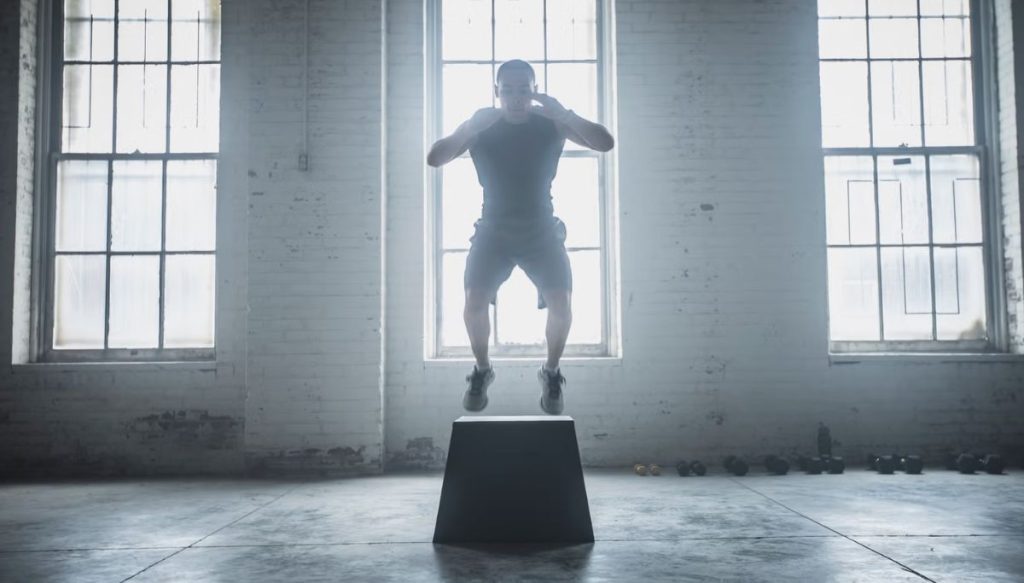
Plyometric exercises like box jumps and squat jumps build muscular power, which NASM defines as the ability to produce large amounts of force quickly, and plays an important role in maintaining mobility and performing daily tasks. Muscular power also declines faster than muscular strength, Kimble notes, which is why it’s helpful for older adults (or any athlete) to focus on maintaining it.
Cyclists of all ages can use plyometrics to maintain muscular power and ward off sarcopenia. However, plyometrics can be stressful for joints, so building a solid foundation with traditional strength exercises is essential before adding jump training. From there, start with lower-intensity plyometric options, such as those targeted at the upper-body exercises, like medicine ball chest passes and plyo push-ups, or limit how high you jump with lower-body exercises, suggests ACE.
Solid nutrition is the other piece of the equation in preventing sarcopenia — protein in particular. One meta-analysis found that older adults with sarcopenia consumed significantly less protein than their non-sarcopenic peers. As protein is the primary macronutrient in maintaining and building muscle, it’s vital to include adequate protein in your diet.
In general, active adults require higher amounts of protein to keep up with the constant breakdown of muscle tissue. Aim for about 1.5 to 2.4 grams of protein per kilogram of body weight per day to help maintain your muscle mass.
READ MORE ON: Senior Cycling