
The Best Core Exercises for Cyclists Who Hate Planks
Discover super-effective, expert-recommended core exercises for cyclists that boost strength, stability, and power — no planks required.
Low back pain ended Lotte Kopecky’s 2025 Giro d’Italia Women by the end of the fifth stage. For the first time in the past five years of her career at the top of the sport, Kopecky had to drop out of a race. That’s just how much low back pain can derail even the strongest riders, even superstar pro cyclists.
Once the issue of low back pain has been aggravated, its fixes will be as individual as each rider and remedies are affected by everything we do off the bike, too. Strengthening our core, maintaining mobility, and setting up good ergonomics in day-to-day life are the Big Three off-the-bike strategies for happy backs.
We’re focusing on the first of these strategies here: building a strong core. Planks are a core workout go-to, and for good reason: they’re super effective, provided they’re performed correctly (a lot of folks don’t). It’s an exercise that is beneficial for every cyclist to master, provided you have medical clearance. Once you’ve mastered the basic plank, it’s a move you can progress with a bunch of different variations, each with its own benefits.
But here’s the thing: a lot of us just don’t like performing static planks. Sure, we may not mind holding a high or low plank, but they’re just not an exercise we necessarily look forward to when they’re up next in our workouts. I, for one, fall into this camp, and a lot of my clients do, too.
Planks are just one of many beneficial core exercises, and certainly don’t need to be the only thing you focus on when you want to work your core. For the plank-adverse among us, I present three of my favourite, super-effective core moves ideal for cyclists — not a plank variation in sight.
3 Core Exercises That Aren’t Planks
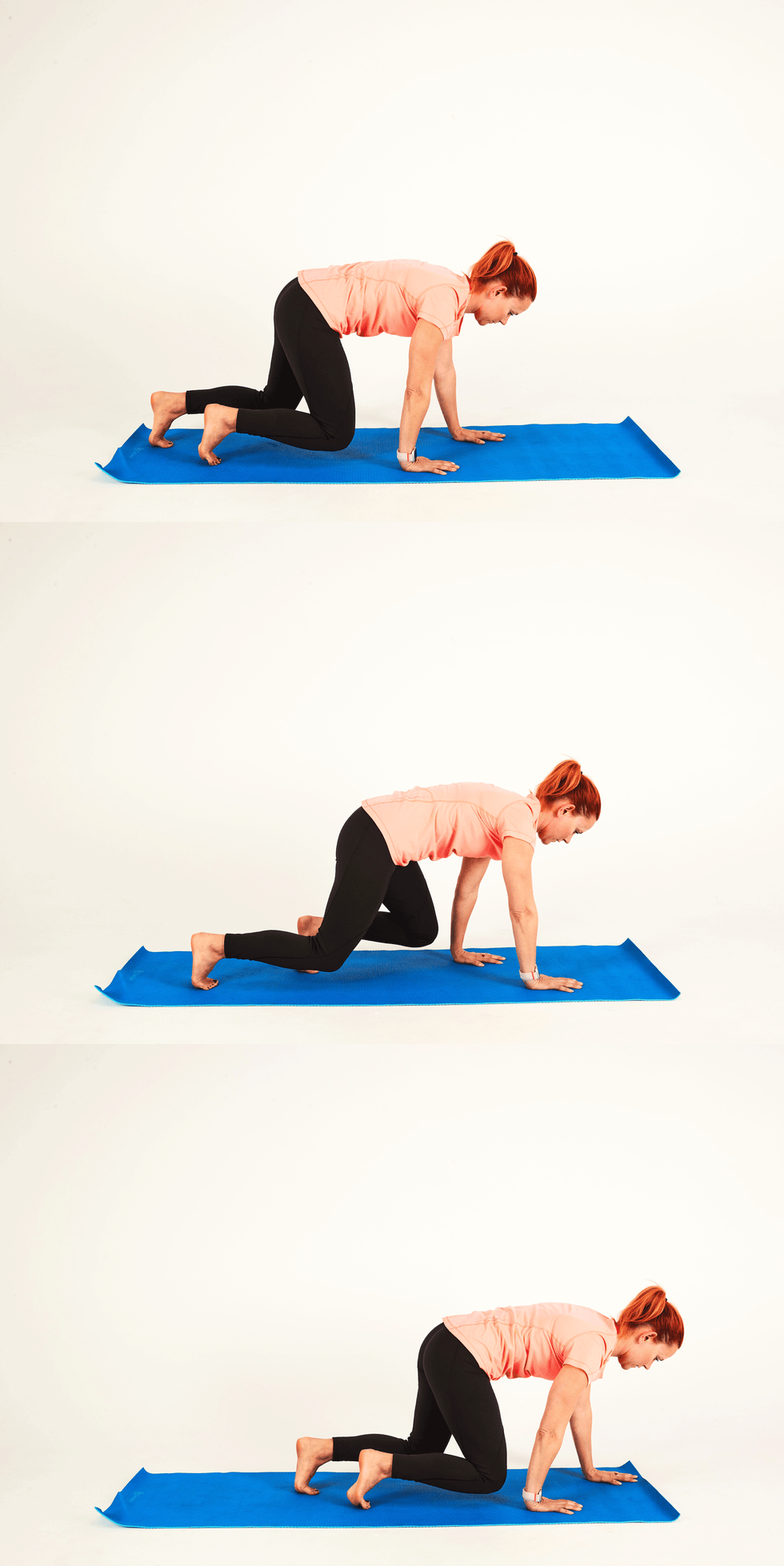
1. Bear Crawl
How to Do It
- Begin on all fours with your hands directly under your shoulders and knees under your hips.
- Lift your knees an inch or two off the ground, keeping your weight evenly distributed between your hands and toes. The back should stay flat, core engaged, and head in line with the spine. This is the starting position.
- Crawl forward by moving the right hand and left foot forward simultaneously, taking a small step. Then, move left hand and right foot forward, keeping the knees close to the floor as you move. This is one rep.
- Keep the steps controlled and smooth, maintaining a neutral spine. Avoid arching the back or letting the hips sag. Maintain the same distance between hands and feet throughout the set
- Repeat for AMRAP for 30 seconds. This is one set. Perform 2-3 sets.
- Breathing: Maintain steady diaphragmatic inhales and exhales at a natural rhythm throughout.
Variations
• Reverse Bear Crawl: Perform the exercise by crawling backward to work different muscle groups.
• Sideways Bear Crawl: Move laterally while maintaining the same principles.
2. Dead Bug
How to Do It
- Lie on a flat surface. Bend knees to a 90-degree angle so the thighs are vertical and your calves are parallel to the floor. Keep the knees centered over the hip joints.
- Extend arms straight up toward the ceiling, keeping them in line with the shoulders.
- Activate the core by engaging the core muscles and making sure the low back is pressed gently into the floor. Avoid arching the low back. This is the starting position.
- Slowly lower the right arm backward toward the floor, keeping it straight. At the same time, extend the left leg forward and down, lowering towards the floor. Important: Only lower the leg as far as possible while maintaining a neutral low back.
- Pause and ensure the core is engaged and the low back isn’t lifted off the floor. Then bring your right arm and left leg back to the starting position. This is one rep.
- Repeat the movement with your left arm and right leg, keeping the movement slow and controlled. Avoid using momentum.
- Continue alternating sides for 12 reps per side. This is one set. Perform 2-3 sets.
- Breathing: Inhale while lowering the limbs, exhale while lifting limbs and returning to the starting position
Variations
• Straight Leg Dead Bug: Perform the same as the regular dead bug but without bending the legs to a 90-degree angle, keeping the legs straight during the entire exercise.
• Unilateral Dead Bug: Perform the same as the straight leg deadbug, but without alternating sides. Instead, perform 12 reps on the right side, then 12 reps on the left side, per set.
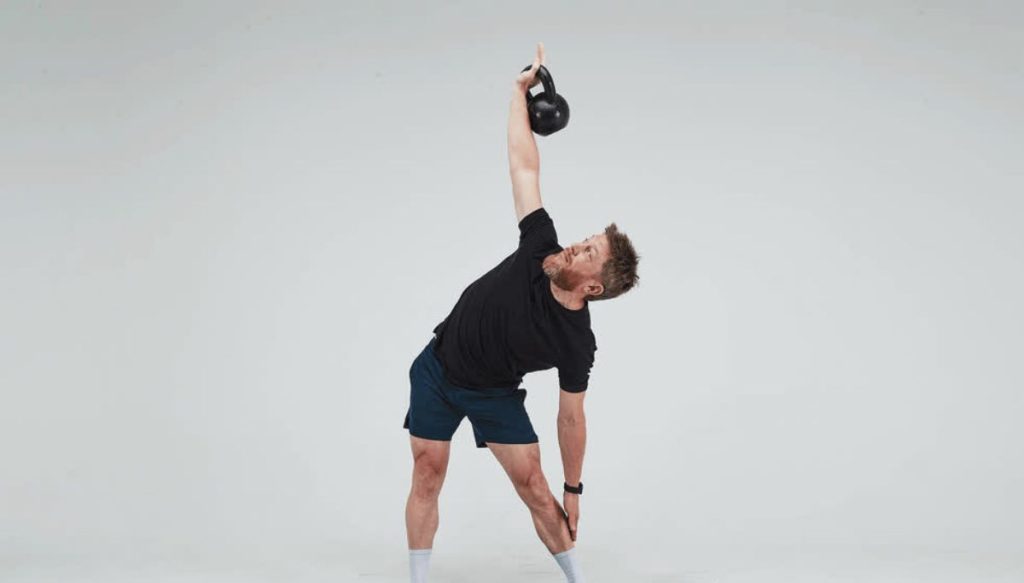
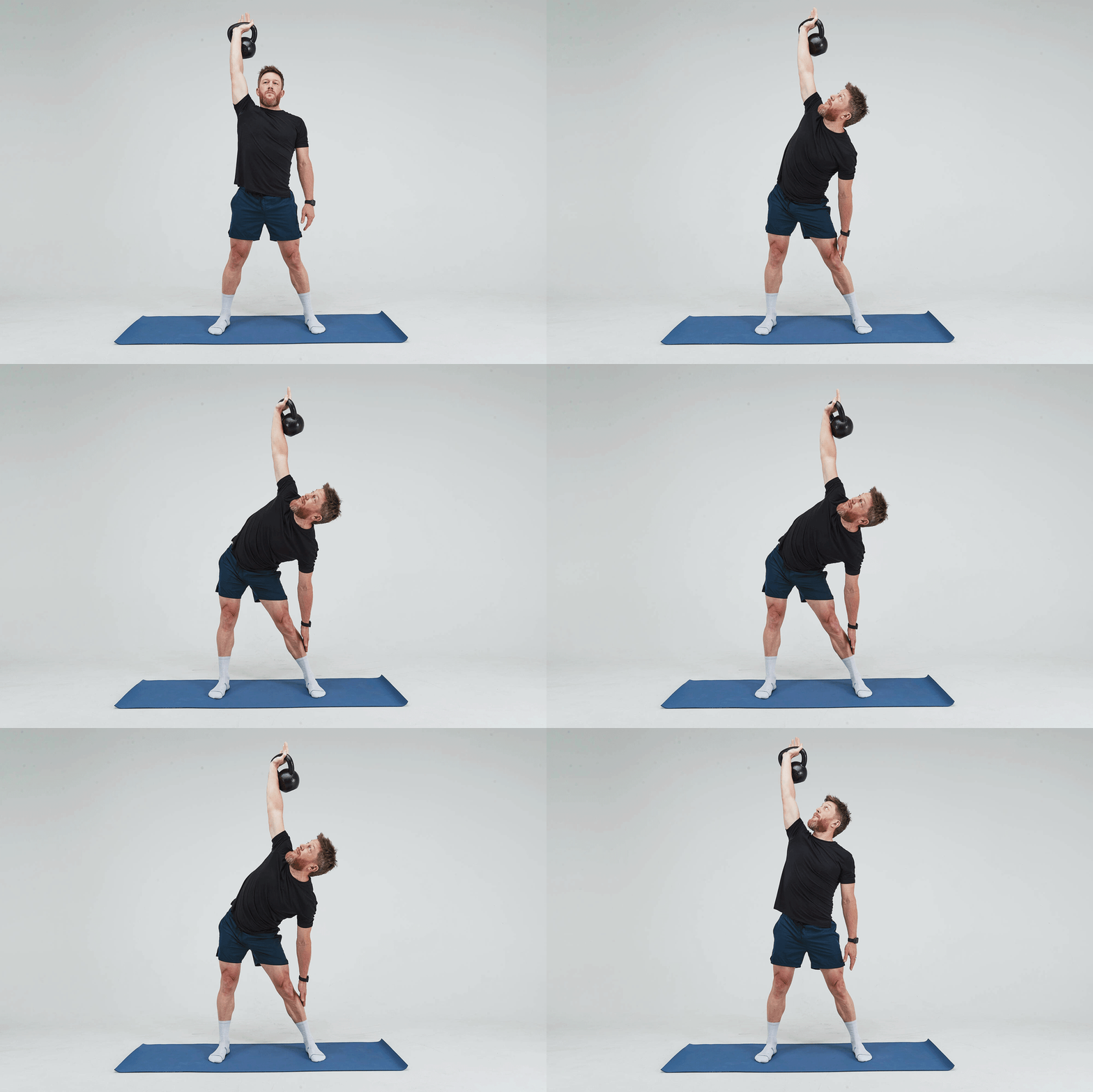
3. Windmill
How to Do It
- Stand with feet slightly wider than shoulder-width apart.
- Hold the kettlebell in one hand and press it directly overhead. Ensure the arm is fully extended with the wrist straight.
- Turn feet at a slight angle, about 45 degrees away from the side of the kettlebell. Engage the core and keep the eyes fixed on the kettlebell throughout the movement.
- Push the hips back and hinge at the hip, lowering the torso to one side, keeping the torso straight. The non-weighted hand should trace down the inside of the leg while lowering the torso. Keep the back straight and avoid rounding the spine.
- Lower the non-weighted hand toward the floor, aiming for the shin or ankle. Maintain the kettlebell in a steady overhead position. Slowly reverse the motion back to standing by pushing through the hips and straightening the torso using the core and glutes. This is one rep.
- Perform 5-10 reps on one side before switching arms. This is one set. Complete 2-3 sets.
- Breathing: Inhale while lowering the torso, exhale while returning to starting position.
Trainer Tips
When it comes to core workouts, I recommend integrating core work into your regular strength training sessions by including 2-3 core exercises during each workout, rather than doing one big core-only workout per week. (Aim for 3-4 strength training workouts per week)
Doing it this way will make it easier to stay consistent, and you’ll develop a stronger core, faster, by thinking of your core work cumulatively over the course of a week. And in my experience with clients, sprinkling in core work in this way makes core exercises in general feel less daunting and/or dreaded.
Take the time to master the form when doing these moves for the first time, and make sure you’re feeling it in the right places and engaging the right muscles. Sometimes what happens is that we end up recruiting muscles in our lower back to do too much of the work during these moves instead of calling primarily on the muscles in our core. This is especially common among beginners but also happens to the more experienced, so give yourself the time to really understand the mechanics of these exercises–you’ll get out of them what you put in.
Another important component of training your core is diaphragmatic breathing, and if this is something that is new to you, I suggest working on learning how to breathe diaphragmatically in tandem with any core workouts you do. In fact, consider diaphragmatic breathing as part of your core work, not an accessory to it. After all, your diaphragm is part of your core, and the benefits of effectively integrating it into the rest of your movement will translate to a massive improvement in your breathing performance on the bike.
READ MORE ON: CORE WORKOUT