Master Your Cadence and You’ll Be A Speedier Cyclist
Here's how to dial in your pedal revs.
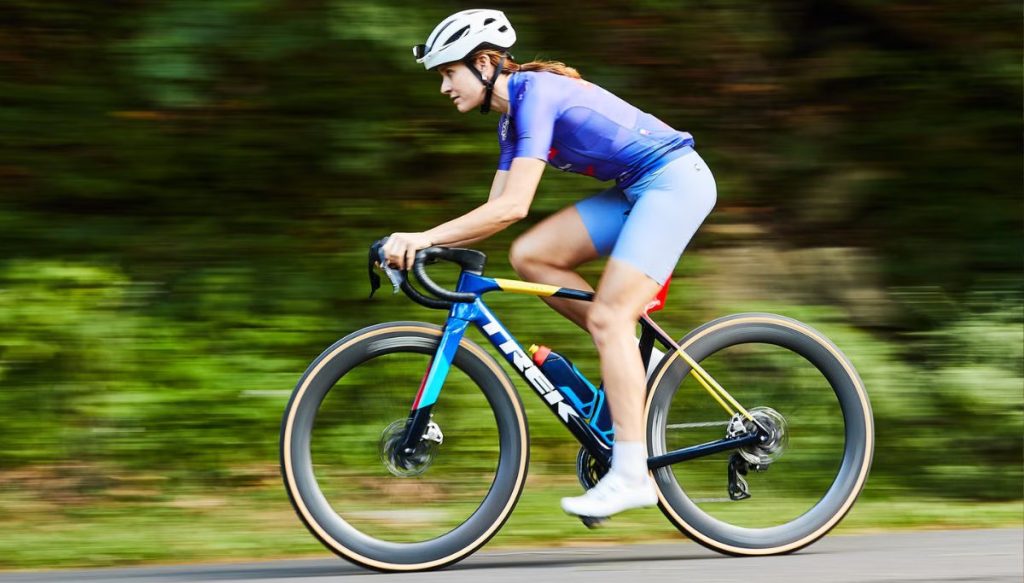
When you think about boosting your speed on the bike, cadence is probably one of the first things that comes to mind. And that’s a good thing; because while it’s not the only factor, it’s a key component.
Cadence refers to the rate at which you pedal, and is measured in revolutions per minute (RPM). You may look at riders next to you and feel like you’re pedalling too slowly or too fast, but the truth is, your ideal cadence is personal to you.
The first step is learning to be aware of your current cadence, so that you can practise maximising it in order to reach your ideal cadence. Achieving ideal cadence will help you sidestep fatigue and control your power output, so that you can hit the cycling speeds you dream about.
Jen Whalen, pro cyclist and host of Bicycling US’s ‘How to Ride Faster’ programme, is here to walk you through it so you can ride with confidence.
How to calculate your cadence
You can use a bike computer, or you can calculate your cadence yourself by finding your RPM:
- Set your timer or stopwatch to 30 seconds, and count the number of times one leg pushes down on the pedal.
- Then, multiply that number by two. For example, if you push down 35 times in 30 seconds, that’s 70rpm.
Alternatively, you can do the same exercise for 10 seconds and multiply that number by six. Once you know your RPMs, you can figure out your ideal cadence.
What’s the ideal cadence?
According to research, most riders should aim for 80-90rpm. But once you’ve calculated your cadence, you can get specific about your individual cadence goals. What you decide all depends on your fitness and muscle type.
Fast-twitch muscle fibres are responsible for faster, more powerful movements like sprints; while slow-twitch muscle fibres are responsible for slower, sustained movements like long rides.
We all have fast-twitch and slow-twitch muscle fibres, but understanding which you have more of will help you find where you thrive in terms of cadence and speed.
We all have fast-twitch and slow-twitch muscle fibres, but understanding which you have more of will help you find where you thrive in terms of cadence and speed. Slow-twitch riders usually do well at higher cadences, whereas fast-twitch riders might prefer lower ranges.
What are the benefits of cadence training?
By lowering your muscular fatigue and working the cardiovascular system, higher cadence work increases your efficiency on the bike and helps you ride longer.
“It’s not mashing the pedals. It’s learning how to pedal efficiently,” says David Lipscomb, founder and head coach of CIS Training Systems LLC, with over 30 years of performance and coaching expertise. “So, utilise force development training as a critical step to get faster on the bike, as it relates to speed and orange-zone training.”
Six things to keep in mind
Before you dive headfirst into cadence work, there are a few things to be aware of:
- If you stay in one gear all the time, consider shifting to an easier gear. Make your practice a little easier!
- One high-cadence workout per week is plenty when you’re looking to improve your cadence. Simply swap an easier endurance ride for a cadence workout, keeping your power/heart rate in the endurance zone as you speed up your pedalling.
- Cadence work doesn’t have to be your entire ride. It’s easy to add cadence drills to any longer ride. Or, cadence drills can be your warm-up. To practise low-cadence work, simply drop your cadence during the climbs on your endurance rides.
- Most importantly, don’t expect changes overnight. As with any progression, you should focus on incremental changes over practice sessions.
- Remember: the goal is to pedal faster while maintaining the same power/speed output.
- Focus on your form while doing these drills. Over time, things will smooth out with your pedal stroke and how you feel overall.
The Drill
Here’s one of Bicycling’s most popular cadence drills. The goal of this drill is to develop cadence transitions, leading to a smooth pedal stroke, and to maintain the same resistance at different cadences.
- Find the gear you need to be in to get to 65% of your maximum heart rate, or an RPE (rate of perceived exertion) of about 6 out of 10. Don’t change your resistance during this drill.
- Warm up with 1 minute at 85rpm, followed by 30 seconds at 95rpm, then back to 30 seconds at 85rpm.
- Repeat the 30-second intervals a total of 5 times.
- Do 1 minute at 95rpm, followed by 30 seconds at 105rpm, then back to 30 seconds at 95rpm.
- Repeat these 30-second intervals a total of 5 times.