Winning Tips To Ace The Double Century
It’s not the strongest rider who wins – it’s the team that works together.
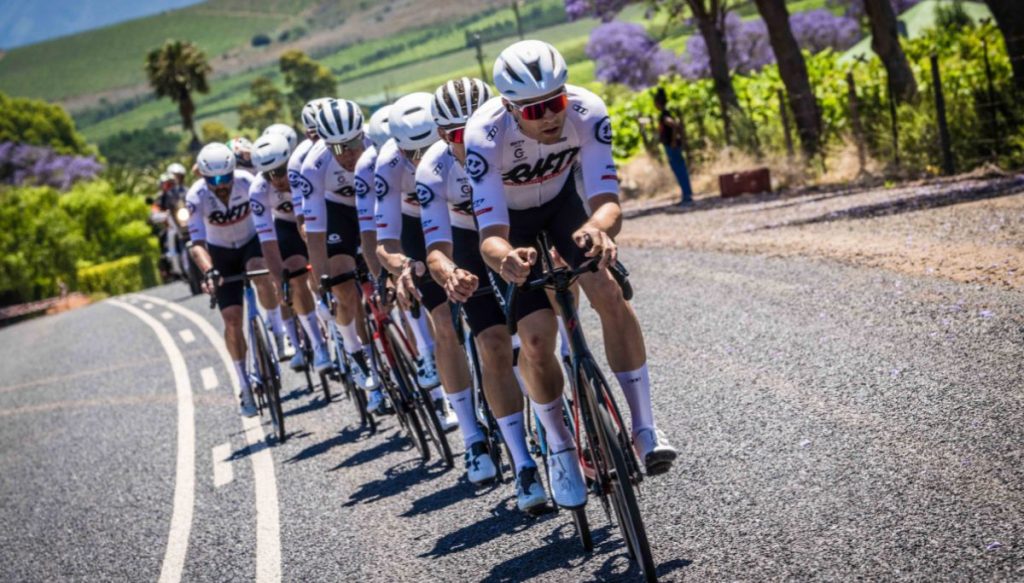
Some teams go to the Old Mutual Wealth Double Century to win; some go for fun. Others go to get 12 riders over the line. Whatever your reasons for riding, the name of the game for a successful 202km DC Saturday is tactics. Arrive with a game plan, and you’ll leave with a result.
What makes the Double Century unique?
A few things, actually. To start with, it’s 202km long – that’s a heck of a long distance, whether you’re an amateur, a pro, or one of those middle-aged ‘semi-pro’ okes in between. The race takes place outside a major centre, so travel logistics play a part in your prep and planning. The 12-person team format is a restriction in that you’re unlikely to find 12 committed teammates who can all train and ride at the same level.
“You need to prepare. You need to train. You need to have your tactics aligned..”
And you stop for a lunch break around halfway, then get back on your bike for another 100km of riding. Add all of that up – plus the fact that the race takes place just after winter, when riders are not always in peak shape – and you have a recipe for perhaps the most unique road cycling event in South Africa.
Small wonder it sells out every year. As popular and fun as it is, though, you can’t simply rock up and ride. You need to prepare. You need to train. You need to have your tactics aligned…
And that’s what this article is all about.

The clue is in the format: ‘team’ time trial
David George, a member of the winning team (RH77-Factory) last year, says the aspect of the race that he enjoys most is the team format, and the mixed ability of the riders in each team. “You’re never going to get 12 riders together who have the same ability or fitness, so it always makes for interesting racing.
“People also enter and then get ill; and each member has different riding strengths. That’s what makes the DC unique – all the characters in a team figuring out how to use their skills. Every rider brings something different to the table, so that ultimately you end up with a decent balance.”
Former winner Jaco Venter agrees with the balance part. “For me, the most important thing for DC success is having a group of riders who are as equal in strength as possible,” he says. “It doesn’t help if you only have a handful of strong riders, and they destroy the rest of the group.”
So, yes, teamwork is crucial to the outcome of your race. But what does that actually look like?
RELATED: The (Mostly) Serious Guide to Surviving the Double Century
Share the load
A major failing of many DC teams is leaving one or two riders to do all the work, while the rest sit in the bunch the whole day. Fast, medium and slow teams are all guilty of this. Yet the only way to survive the Double Century is for every rider to do his or her part. This also speaks to the team dynamic of the event: keep the team involved right to the end, and you have more chance of success.
If the team’s happy, then the ride goes well.”
“Over the years, I’ve found that if everyone is given a role, then the team is happy. If the team’s happy, then the ride goes well,” says George.
His advice for snappy team racing is for each rider to do quick, short turns at the front. “I’ve always been a fan of doing this, as opposed to long, hard pulls. Get a double paceline going, get to the front, pull for a few seconds, and immediately drop down; and let the next rider pull up as you slowly make your way to the back. Historically, this strategy has always worked well at the DC.”
Venter concurs: “The stronger riders can maybe do longer pulls on the front; but they must keep the surges to a minimum, so they don’t hurt the rider who just pulled off and who’s now on his way to the back again.”

Communicate!
“The DC is not about the strongest rider,” says Felix Ritzinger, also one of 2024’s winning RH77-Factory team. “It’s about pacing smartly, maintaining that pace, and looking after your teammates on the road.
“It all comes down to communication. If you’re the strongest guy, that doesn’t mean you have to make it hard for everyone. You need to work with the strengths of the team, and communicate the strategy while moving through the bunch.”
Venter agrees that communication is critical. “Tactics are so important on the day. You need to communicate constantly to make sure everyone is on the same wavelength,” he says.
“For example, with the 30-minute neutral zones, it’s an option to burn riders close to those stops so that some team members can take it easy while the others work; then later in the race, the riders who rolled through at a slower pace have the legs to attack near the end. But this only works if there’s clear communication.”
George adds: “If one or two riders are simply sitting at the front, they have no idea what’s going on behind them, and that’s when your plans can go awry.”
Don’t go till you blow
The DC is a long day out, even for the winning teams. “It doesn’t matter who you are,” says George, “202km is far – even the top teams are in the saddle for around five hours. That’s a tough day of riding. You can’t go flat out from the start, because you’ll lose half your team on Tradouw Pass; and if not there, on Op de Tradouw.”
George says the tactic of short stints at the front of the paceline not only helps to ensure you don’t lose riders on the first climb of the day; you’re also able to establish a hierarchy within the team for the rest of the race. “By riding slightly conservatively at the start, you can work out the team strengths.”
“The second half is crucial. It’s in that final sector that you know whether you’re going to win or you’re going to blow up.”
Venter notes that it’s easy to fall into the trap of flying out of Swellendam when everyone’s feeling strong; but that’s a tactic that always comes back to haunt you later in the race. “The second half is crucial,” he says. “It’s in that final sector that you know whether you’re going to win or you’re going to blow up.
“That’s why it’s important to take it relatively easy on those early climbs. When you get to 40km to go, and you’ve gone too hard at the start, you can lose minutes very quickly on the final, steep climbs.”
Managing your effort on the climbs is make-or-break at the DC. “This is a race that hurts from start to finish,” says George. “You’re not going to win it in the first 100km. Your team can’t be down to six on that first climb already, so everyone has to get over it together. Thinning of the group too early is a common mistake. After Op de Tradouw, you can regroup and go harder, after losing a few minutes on the climb.”
Venter adds that it’s important not to take the event lightly. “It’s a race in which it doesn’t matter how strong you are. You‘re always on your limit – because if you’re strong, you work harder; if you’re not as strong, you fight to do as much as you can without dropping or letting the group down. It’s a tough day out for everyone.”
Use your team wisely
There are 12 riders in a Double Century team. Winners seldom finish with all 12 together, opting rather to cross the line with only six – the minimum number required to finish officially. This means you have six spare riders at your disposal, so to speak, to do with as you please over the course of 202km.
“The RH77 strategy last year was simple,” George says. “Get six people and maybe one or two spares to the middle feed zone, then get six people to the end. With that strategy, we needed to go through halfway as best we could, and then really attack after the stop.
“But you still don’t know how it will play out! In the second half of the race, after we’d dropped six riders, I realised I was now the sixth rider in the team; so I had to hang on with a bit of pressure…”

Don’t be a fool. Fuel!
In this day and age, there’s no excuse for making nutrition or fuelling errors at endurance events. Yet it’s something that riders still manage to overlook, either by planning poorly or through getting caught up in the moment. Bottom line: if your nutrition strategy is faulty, your ride is going to falter.
RELATED: How to Fuel a Monster Ride
“Not managing your fuelling can ruin your race,” says George. “It’s much easier now than it was in the past, thanks to new products and better knowledge; and I think people are more aware of their fuel requirements… And yet riders still get it wrong sometimes.”
George adds: “Very simply, buy the best products you can afford, and train your gut to accept them at high capacity.”
The most common error seems to be not using your chosen product on training rides, or changing your nutrition just before a race. “If you can absorb carbohydrates efficiently, you’ll perform at a higher level on race day,” George says. “It’s totally something you can train for.
“The problems come when you start eating gel after gel on race day, and you expect your gut to be acclimatised to the high carb load. You might not get sick, but you’re not going to be effective.”
To get your gut ‘in shape’, make sure you’ve done some five-hour rides – big, hard rides – well-fuelled, at 90g of carbs per hour. “Everyone should be at 90g per hour on a 200km ride,” George says. “Even if you’re going slowly, you should be doing that.
“Fuel early and taper, rather than fuelling late. If you’re well-fuelled, you don’t need to worry about cramping either, because cramping is a result of incorrect fuelling and not enough electrolytes. Cramping and bonking shouldn’t be a thing anymore.”
READ MORE ON: Double Century Winning Tips