
If It’s Not On Strava, It Didn’t Happen
After 15 years, Strava has become ingrained in the lives of cyclists. It records your ride and adds a layer of fun: segments, leaderboards and trophies. For some, these are amusing extras; for others, pure motivation. What exactly makes Strava so irresistible?
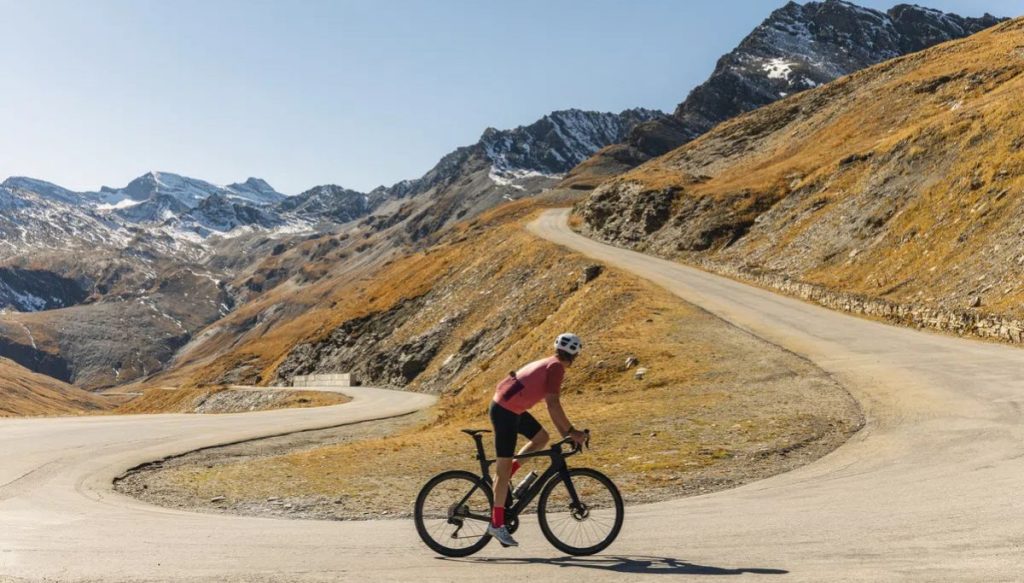
Anyone who gets into conversation with Remmert Wielinga (37), once a pro rider for Team Rabobank, is quickly swept up in a stream of anecdotes – about climbs, records, and attempts that only just fell short; about a love of endurance sport and competition; and – above all – about Strava.
One of the first names to come up is French pro David Gaudu. He took a KOM off Wielinga.
(Hang on, let’s take a step back. In case you think we’re speaking Dutch or Afrikaans here: ‘KOM’ stands for ‘King of the Mountain’. The women’s equivalent is ‘QOM’ – ‘Queen of the Mountain’. Whoever sets the fastest time on a segment on Strava earns a coveted digital crown.)
“It’s mostly a fun form of motivation; but for a few super-fans like Wielinga, it’s a religion.”
Wielinga immediately messaged Gaudu. “I told him I’d take it back. And I did!”
Gaudu had claimed the KOM on a climb out of Menton, France (on the Mediterranean coast), with about a thousand metres of elevation gain. Practically in Wielinga’s backyard, as he lives in Monaco. He says he didn’t even have to dig especially deep to reclaim his title. He’s pushed himself much harder for other KOMs…
KOM hunting in the Alps
It doesn’t stop at one story.
Wielinga talks about holding the fastest time on the Col de Gavia, one of the toughest climbs in the Alps. He’s two minutes faster there than the mighty Tadej Pogačar. He’s also faster than Pog on another long segment, between Nice and Monaco, which is more than 20km in total. On that segment, the world champ is still over a minute slower than Wielinga.
(Not an insignificant detail: Wielinga rides a relatively old, converted time trial bike, which is noticeably heavier than the machines used by today’s pros.)
It’s interesting that Wielinga is hardly interested in talking about his professional career – not about his time at Rabobank, the missed opportunities, the suggestion that he might never have reached the full potential he’d shown as a young climber, or the fear of riding in a group that once held him back.
No, he wants to talk about Strava – the platform that reignited his motivation after life as a pro.
Wielinga has nearly 3 000 KOM crowns in total – far more than pros like Pogačar, despite the fact they both ride in the same areas around Monaco. Yes, even the Slovenian superstar has to bow to Strava’s unofficial title of KOM King – a title the Dutchman wears with obvious delight.
“The secret of Strava?” he asks with a grin. “Segments. That’s the key ingredient. Other apps don’t have that. The segments have turned cycling into a game.”
Yup, the gamification of cycling – and of running – has changed the lives of amateur athletes. Strava tracks, motivates, challenges and rewards with addictive little hits of dopamine when you beat a personal best or make it onto a top-10 list. It punishes sometimes, too, but even the least tech-savvy riders have embraced the app. It’s mostly a fun form of motivation; but for a few super-fans like Wielinga, it’s a religion.
He’s not alone. Take the Kopje van Bloemendaal near Amsterdam – maybe the most prestigious Strava segment in the Netherlands. Years ago, Dutch pro Niki Terpstra, journalist Thijs Zonneveld and a young talent called Derk Abel Beckeringh were locked in battle over it – each trying to outdo the other so fanatically that they used sprint trains and even temporary road closures in an attempt to set the fastest time up the 1.3km climb.
Strava as a second career
‘If it’s not on Strava, it didn’t happen.’
Not everyone is as extreme as Wielinga and his compatriots. But there’s room for everyone on Strava – you’ve probably heard this now-well-worn catchphrase mentioned in your own riding circles.
So ubiquitous is the app that there have been cases of it saving lives. In 2018, the wife of former pro Steven de Jongh broadcast an appeal for help after her husband went silent on a ride near his home. De Jongh was found unconscious in a ravine next to the road he’d been cycling on – thanks to Strava users narrowing down his position. “Strava, you’re a lifesaver!” his wife tweeted later.
But it takes lives, too. There are just as many stories of people literally killing themselves in pursuit of a segment crown. And of military personnel inadvertently revealing their ‘secret’ positions thanks to uploaded training data.
According to Strava’s annual report, the platform has 180 million users across 185 countries. In 2025, 7.6 million people claimed a KOM or QOM, and all in all, users handed out 14 billion ‘kudos’ – the digital thumbs-up that athletes use to congratulate each other on a performance. (Wielinga says he wouldn’t mind seeing a few more kudos under his own rides, from his 1 300 followers…)
After retiring from pro cycling in 2011, Wielinga switched to triathlon, until his wife fell pregnant in 2017. He stopped competing then, but immediately went looking for a new stimulus. In case it’s not already obvious: competition runs pretty deep in Wielinga’s veins.
“It’s not about proving anything,” he says defensively. “I’m actually just curious. How much better can I still get at my age? Those segments are the perfect incentive.
“I spoke to [UCI WorldTeam Lidl–Trek’s Dutch pro] Bauke Mollema about it, before he announced that he’d also be retiring this year. He said he’d never be able to live like I do – chasing KOMs, and all that. I understand.
“But I also know he’s a very strong runner, and I’m fairly certain he’s going to start targeting age-category marathon times… It’s just in our genes.”
The first time Wielinga heard about Strava was in a bike shop. He had no idea what it was, and listened curiously as the owner explained it.
“I thought it was strange – that everyone could see where I’d been riding, what I’d been doing… Wasn’t that an invasion of privacy?”
But the question kept nagging: After retirement, how could he carry on achieving?
“That’s what drove me,” says Wielinga. “I started focusing on particular segments, and it just grew from there.
“In 2019, things really ramped up. Strava got bigger, as did the online cycling community in Monaco. All the local pros were on it, and I got swept along. I hated selfies and Instagram – this felt like a much nicer way to share something about myself.”
An empire of data
How does a training app build such a vast user network? To answer that, you have to go back to the beginning.
The founders are two Americans, Michael Horvath and Mark Gainey, who had both been competitive rowers when they studied together at Harvard University. They missed the sporting environment they’d left behind, and came up with the idea of creating a sort of digital locker room – a place to stay connected with former teammates and other athletes.
That idea came to life in 2006, when the technology finally caught up; and the name became Strava, derived from the Swedish word for ‘to strive’. Before long, they’d worked out exactly what athletes find addictive: sharing, comparing and chasing rankings – much like in gaming, where scores and records are the engine that drives the whole enterprise.
More importantly, people kept coming back – for more competition, more reward, and more connection.
As with other major tech platforms, the Strava founders wanted their own platform to become part of everyday life; and it was fast becoming that way, thanks to their addictive cocktail of kudos and competition. More than that, Strava offered connection in an increasingly individualised sporting world. In the early days, users were mostly a certain kind of middle-aged man on a road bike. In 2011, a separate running app was briefly introduced, before being folded back into the main platform.
And today? People can Strava almost any activity, from inline skating to table tennis, and even underwater hockey. (And did you hear about the guy who recorded his walk down the aisle at his wedding?!)
The social interaction on Strava is more rewarding than on other sports apps, and fits seamlessly into the age of social media. After all, who still rides or runs these days without someone else seeing their achievement, without getting or giving a compliment, or checking out a new route?
We’ve long since stopped exercising purely for ourselves. The endorphin hit of a thumbs-up is motivation for the next training session. It also gives you a sense of belonging – a place within your chosen community.
And let’s not forget the open voyeurism. A little harmless snooping on a clubmate’s fastest times, maybe, or a racing rival’s training? Or seeing what your ex-girlfriend is getting up to… Strava puts it all out there. Well… mostly.
For years, Strava has positioned itself as ‘the Switzerland of sports apps’ – a neutral third party that is compatible with all watches, bike computers and data sources. But that neutrality came under threat in 2025, when Strava clashed with Garmin and threatened to block Garmin users. Both sides eventually backed down, and Strava returned to neutrality. For now.
Total transparency
Wielinga also sees Strava as an opportunity to make cycling more transparent. “You can see how the pros train – isn’t that brilliant?” he says. “Back in my day, everyone always looked at us sideways: ‘Oh, they must be doping, that’s why they ride so fast.’
“Strava offers a way to show the bigger picture. Of course, some riders deliberately choose not to share anything – or they choose what they share – but the platform has the potential to provide so much clarity.”
He proposes a radical idea: “All the major players – ASO, the UCI and all the pro teams – they should sit around a table and agree to make all their training data public. And where better to do that than on Strava?”
That will probably never happen, but Strava will continue to evolve nonetheless. After taking serious steps towards a stock exchange listing, scheduled for as early as the fourth quarter of 2026, the app wants to make heavier use of AI to give users a personal trainer in their pocket.
Strava’s business model is changing, too, as free features slowly fade away. Years ago, struggling to turn its huge user base into profit, the platform reached a crossroads: choose paid subscriptions, advertising, or selling data? They went for the subscription model; and while they struggled initially, the subscriptions eventually snowballed. Estimates in early 2026 place annual global earnings at close to US$500 million.
For Wielinga, none of the business stuff really matters. He’ll keep using Strava with enthusiasm – and is already plotting his next KOM attack.
Who has the most KOMs?
Strava has spawned a whole bunch of third-party web apps that delve deeper into the data, including one called ‘Toolbox for Strava’ (Google it) – an opt-in service that provides additional reports and stats for connected users.
It’s almost impossible for anyone without insider access to Strava’s back end to determine which user holds the most segment crowns; but of the users who have opted in to Toolbox, an individual mysteriously named ‘D . M’ has a staggering 15 340 KOMs. An Aussie called Glen Morris is second, with 13 765, and a well-known American Strava fiend called Keith DeFiebre comes in at fifth with 8 400 KOMs.
It’s even more difficult to say which South African man or woman has the most KOMs on local soil. But it’s safe to say the segment hunters ride among us – and they’re not always the obvious guys or girls in sponsored kit…
>> This article originally appeared in the magazine. To never miss a story, subscribe to the digital version here.
READ MORE ON: strava