Byron Munton’s Second Chance at Pro Cycling
South African cyclist Byron Munton has overcome personal tragedy and mental health battles to emerge as South Africa’s rising star on the world stage.
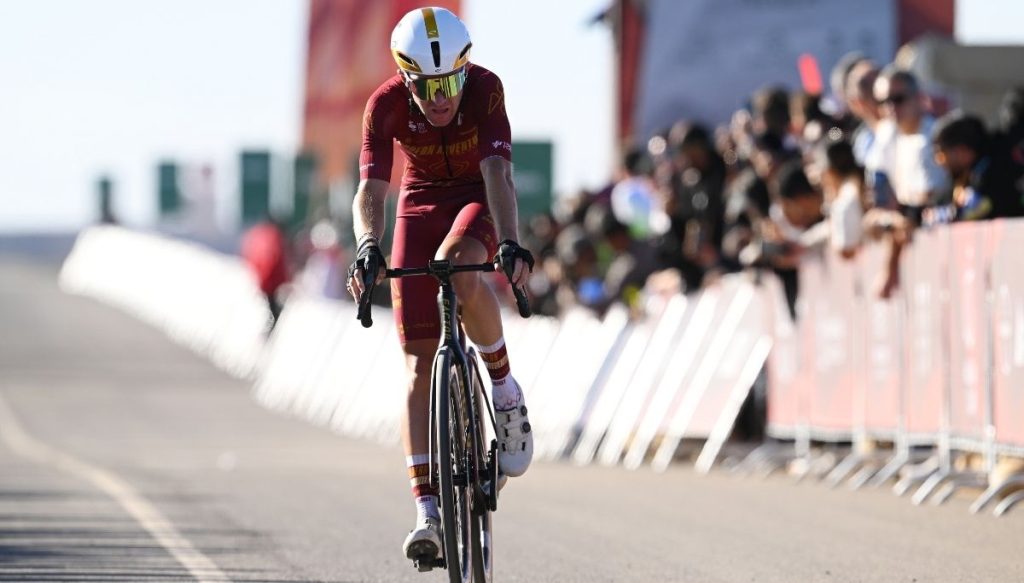
It seems that if you’re a South African cyclist, when it comes to racing in Europe you’re destined to have to make it the hard way.
Ask any recent local retiree from the World Tour or European racing scene, and they’ll gladly list the hurdles that need to be overcome just to line up in a start chute on European soil. From visa headaches, to foreign languages, to a racing scene that initially shocks young South Africans with its ferocity, the step up from local to international racing is a Godzilla-like stride that only the very determined can achieve.
Byron Munton (27), from Hout Bay in Cape Town, is the latest in a steady stream of South Africans digging deep to make it big in world cycling. Thanks to his Belgian passport, he’s been able to race in Europe since leaving school (which helps address at least one typical roadblock for South Africans wanting to compete overseas).
Still, it was only in 2025 – thanks to his stellar performance at the Volta a Portugal, where he won stage four and finished third overall – that some serious players in cycling took notice of his talents. As luck would have it, Munton’s peak in performance was timed right to pique the interest of a new team that was taking shape: George Hincapie’s Modern Adventure Pro (MAP) Cycling.
“I like to think that some of my earlier results made people take notice; but it was really after the Volta a Portugal that things started to change in my career,” Munton says, via video link from his new home town and team training base in Girona, Spain. “MAP’s sporting director, Alex Howes, followed me on Instagram after I won that stage in Portugal. He wrote to congratulate me.
“After the race, I sent Alex a message back to say thanks; and I said a few teams had been talking to me, but would MAP be interested in taking a chance on me?
“Incredibly, everything turned around. And now I’m in a position where I have a two-year contract with a new team, and I’m just really enjoying this environment.”
“Not long after that I was on a call with Alex and another of the team’s sporting directors, Ty Magner; and then quite quickly after that, George Hincapie himself called to say there was a spot for me if I wanted it. And that was that!”
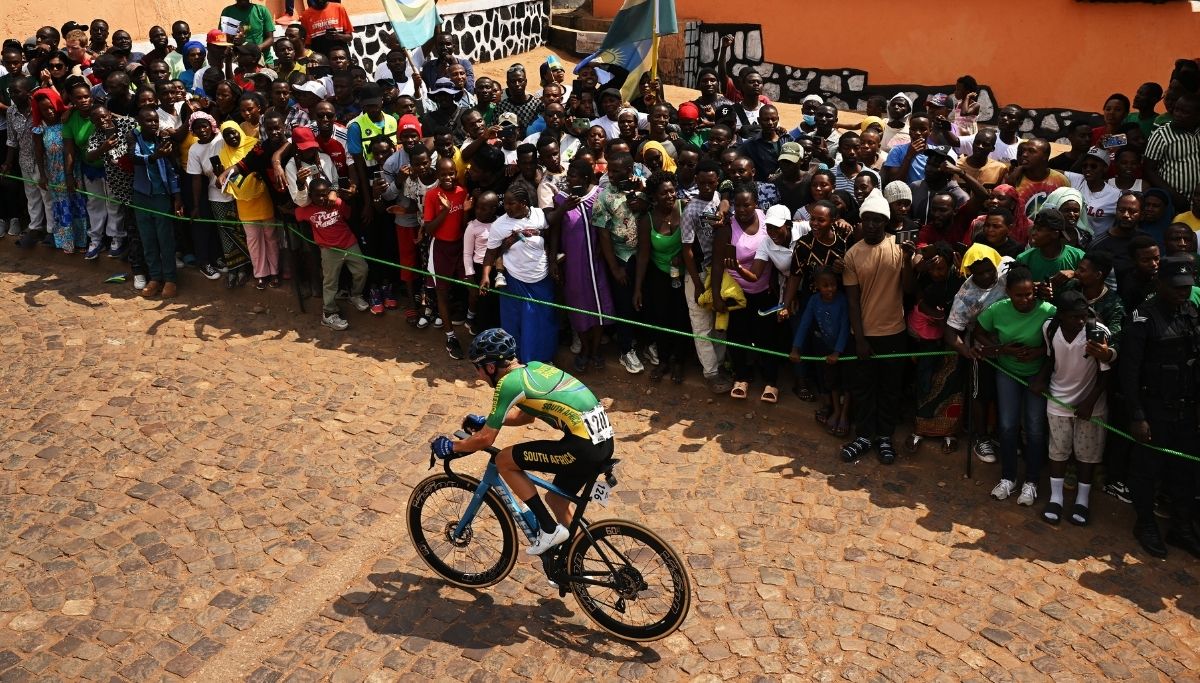
At the time, Munton – callow youth that he is – was unaware of the magnitude of having someone like Hincapie call him up to offer a place on the team roster. “You know, I didn’t understand how big a deal it was, in the moment. I only started cycling quite late in life, in 2015; so that generation of riders was totally foreign to me. I knew nothing about George or his peers.
“Even now: I’m being coached by former Paris-Nice winner Bobby Julich, who also finished third at the Tour de France once and has worked with Team Sky and Team Saxo-Bank. It took me a while to realise that I have these really influential people behind me. And I think I took it for granted at the start, because in the moment, I had no idea.”
Hincapie’s call came at just the right time for Munton. For a while, at that point, he’d been thinking of pulling the plug on an eventful (if not overly fruitful) pro cycling career. “I had actually made up my mind that 2025 would be my last season,” he says. “I’d had a rocky start to the year, and wasn’t where I wanted to be; so I made the decision to have one last year, and just enjoy whatever came my way.
“Incredibly, everything turned around. And now I’m in a position where I have a two-year contract with a new team, and I’m just really enjoying this environment.”
MAP’s ambition is to shape the future of American cycling by developing top talent. As their mission statement reads: “Success is about more than results. It’s about joy in the process, strength in the collective, and riding with purpose, grit, and gratitude.”
To that end, they’ve packed the team with seven American riders under the age of 25, five seasoned American ‘veterans’, and a smattering of New Zealand and British riders. Well-travelled and experienced South African pro Stefan de Bod, formerly with Astana-Premier Tech and EF Education-EasyPost, is also part of the team line-up.
“I think there’s that South African mentality between us of proving a point, that we’re not here to mess around; we’re here to get results.”
“Having a few foreigners in the team is not really affecting the goal,” says Munton. “I think as long as the team is thriving, it will uplift the US cycling community. They don’t mind if it’s an American, a South African or a Kiwi winning.
“Of course, having Stefan in the team is very cool, too. When I started as a junior, I got a photo with him at one of the National Champs in South Africa, where he’d finished second in the under-23 race; and now we’re roommates, on the same team!
“We’ve pushed each other really hard here. I think there’s that South African mentality between us of proving a point, that we’re not here to mess around; we’re here to get results.”
Familiar beginnings
Munton was inspired to start riding after stumbling across the Vuelta a España on television. It was the era of Chris Froome and Alberto Contador.
“It was purely a coincidence,” he says. “I was watching TV, and Froome and Contador were fighting it out on a hilltop finish. My dad had just bought a bike so that he could get fit, but then I saw it as an opportunity to get out of the house. Because we lived in Hout Bay, I started riding up and down Chapman’s Peak almost every day.”
The monotony of the route soon took hold, so Munton started looking around for races. He joined Kinetic Cycling Club, then fell under the guidance of respected South African coach Barry Austin for a spell. “With Barry, I raced in Belgium, France and Spain… he was the one who managed to get me to bridge from South Africa to Europe.”
But all through the period, there was no special moment – no ‘click’ – at which Munton thought he could tackle a pro cycling career. As he says, it was just the footage of Contador and Froome that pushed him on. “It was just awesome the way they fought on that climb, and that stuck with me.”
Instead, as he raced harder and more competitively, he began to realise that his ability wasn’t an acute awareness of race tactics or superior cycling instinct, but rather the ability to go hard on limited preparation. “I discovered that I was able to destroy myself on the bike and get a lot further into a race than I had any right to, based on my fitness at that time,” he says.
At this point in his career, Munton was racing crits; he then moved on to local races in the Western Cape. “I would get 60 or 70km into the race, and then just explode – I could go full gas up until a point, and then just completely bomb out. “It took me a few years to get to the end of a race. And then from there, I was able to start winning them.”
With local wins under his belt, Munton went straight from school to Belgium, with no other plan than to race. “Looking back, it was a bit naïve,” he says. “I was focused solely on racing – it was bikes and nothing else.” It was a baptism by fire. “You rock up at the races overseas, and there are a hundred riders ready and able to win. They’re so determined.
“It was a bit of a wake-up call. The level of technique and skill is so high, compared to the average race in South Africa. These guys are racing day in and day out; they give it everything to be competitive.”
That level of competition and intensity was an eye-opener for Munton; but he found his groove towards the end of his first year in Europe, when the opportunity arose to race in the Tour of Bulgaria. “If anything, this was when I figured out my place in racing. It was one of my first stage races, and I feel like stage racing is where I’ve always been able to do my best. So, after the Tour of Bulgaria, I knew what direction I needed to go if I wanted this to be a long-term project.”
The ability to endure the rigours of stage racing has seen Munton embrace the format. “I have a good ability to recover, day after day; then, being a smaller rider, the hard terrain stages and mountain stages really suit my style and ability. I’ve found lately I respond well to big training blocks, so I’m excited to see what comes next.”
A tragedy, a timeout and a reset
With the AlUla Tour, UAE Tour and Volta a Catalunya all under his belt this year, Munton is enjoying a breakout season as a pro rider. His determination to succeed is rooted in a desire to compete at the highest level – but also to race in honour of his sister, Jessie.
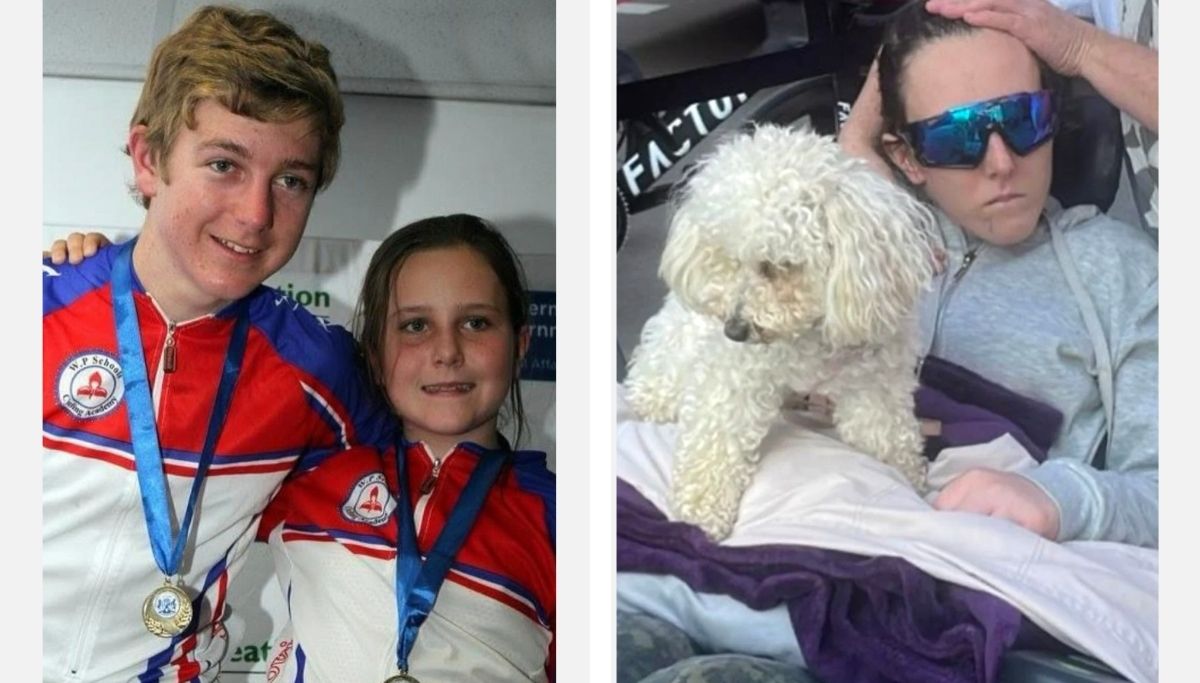
In mid-January 2024, Jessie – then 15 years old – was struck by a car while out training. A promising cycling talent like her brother, with her own dreams of European racing and Olympic participation, Jessie suffered severe brain damage from the crash, and spent a month fighting for her life in ICU. She was put into an induced coma, and only woke from it eight months later. She requires round-the-clock care, and will continue to require it for the rest of her life.
Adding to the tragedy is that the Munton family had already made the decision to relocate to Spain; they’d bought air tickets, and shipped their possessions overseas, so their children could ride and race on European roads.
“I had already been based in Spain for two years, and Jessie was following in my footsteps,” Munton says. “She wanted to be here to race, and for the safety aspect of training. My parents and Jessie were meant to leave South Africa in February that year. It was a month’s difference – we’ll never know how different her life could have been.
“I know a crash can happen anywhere, but I do feel the chances of something like this are a lot higher in South Africa.”
Munton was in South Africa at the time, but after three weeks of training and visiting his sister, his parents eventually encouraged him to get back to Europe to “do his thing”.
“After Jessie’s accident, I was back on the bike three days later, which in hindsight wasn’t the best thing. I just never stopped to process what had happened.”
Being in Europe and away from the family, Munton never had to deal with the day-to-day reality that his parents – and sister – were facing. It was only once Jessie had recovered to a certain degree that the family could follow through on their relocation plans and finally moved to Spain, where their first stop was Madrid.
It was then that Munton’s personal and professional life came to a grinding halt.
“Only once my parents got to Spain did I see and face the reality of what they and my sister were dealing with. I saw then that Jessie wasn’t the sister I’d had before.” The impact was immediate. “I just went on a downward spiral,” he says. “Around March last year, I came back from a short holiday. I started racing, but I got sick. I started training again, then got sick again. I didn’t realise it at the time, but it was my mental health that was a total mess.”
Rock bottom came at a race in Spain, where after the 10km neutral zone, Munton found he just couldn’t go on. “I couldn’t move. I couldn’t keep going. For two weeks in the build-up to that race, I hadn’t been able to eat anything, and my body was just shutting down.”
Realising he needed help, he phoned his then-coach, John Wakefield. Wakefield suggested a psychologist, and a road to recovery began.
“I started working with the psychologist, but I still felt like I needed more help,” says Munton. “I decided to check into a clinic; and that’s when things really started to turn around. I spent a month there doing nothing. I was put on some meds that helped reset my body. “Ultimately, I was going through a sort of midlife crisis, piled on top of a few other things. And while I was at the clinic, they also diagnosed me with ADHD. I would say, that was really the turning point in my career.”
The ADHD diagnosis finally allowed Munton to understand himself better, and as he says, “put the pieces of the puzzle in the right order”.
“I finally understood who I was, and how and why I did the things I did,” he says. “After the diagnosis and treatment, I was able to work things out, to have a better understanding of myself and my body… It meant I started performing more consistently in races. Suddenly, I was able to go in a straight line, instead of going around in circles all the time.”
Up until then, Munton had also been living with anxiety. But knowing no different, he always just assumed that’s how people were supposed to feel. “I didn’t know I had it until I didn’t have it anymore. My time in the clinic changed everything; now I could understand what was happening. Now I could move forward.”
Everything clicked into place. And with improved results came the career renaissance at MAP. But his cycling ambitions are still fuelled by the desire to ride for his sister, whose own ambitions were so cruelly cut short.
“It’s why I ride now. I do this for Jessie. It’s my purpose, a bigger purpose than just riding a bike.”
“It’s why I ride now,” says Munton. “I do this for Jessie. It’s my purpose, a bigger purpose than just riding a bike. I’m not just riding for my own dream, but also for her dream. That’s a big part of who I am now.”
Fresh team, fresh start
With a new team, renewed passion for cycling and new personal ambitions, Munton is embracing his second start in professional cycling.
MAP – who have also embraced Jessie, riding with #keepfightingjess stickers on their team bikes – have strong financial backing, a six-year plan, in fact; so at the moment, it’s a relatively stress-free environment in which to race. Early results for the team have also been encouraging, alleviating any potential late-season pressure.
“Results are not a team objective at this stage; it’s more about getting us to ride as a unit in 2026,” Munton says. But these are still dedicated, elite athletes, and with passion comes performance.
“We’ve started quite well, I think. Earlier this year, we rocked up at the AlUla Tour – our first pro race as a pro team – and Stefan finished fourth on the GC, and I got a second-place finish on the last stage. So even with that one event, I think we’ve got more results than the team expected to achieve in the entire year.
“Then we were at the UAE Tour – obviously a World Tour race, and the pinnacle of the sport. This was another step up for the team. I had a few top 10s there and finished 14th on GC, which I think was pretty crazy.”
Munton adds that his personal performance at the UAE Tour felt surreal at one point. “I was on the climb, listening on the radio, and my team manager kept updating me with the riders who had dropped off; and all I could think was, ‘These guys have won Grand Tours and stages at the Tour de France, and I’m up there with them!’”
Munton’s Methods
Top tips from our top Tour man.
Do the basics
The main thing I’ve learned – for everyone, from beginner to World Champion – is getting the basics right before focusing on the tiny details. I see way too many people worried about getting 100g lighter on their bike, or getting an aero helmet, when they should just be worried about training consistently. If you ride or train consistently, that will be the biggest performance advantage you’ll ever get. Absolutely nothing beats consistent training.
Food form
Eating well is key. You can treat yourself – I have a dessert every night – but you should try to eat healthily.
Make the right choices
Balance is everything. Don’t sacrifice a family day to go and ride. Your life balance is more important than riding; you can ride any time.
I know it’s a contradiction to me saying, ‘Ride consistently!’, but you need to make time for your family and your well-being.
Teach yourself tech skills
Know your repair basics. It’s pretty important to know how to change a tyre, for instance. You don’t want to be stuck 60km from home and have no clue what to do.
Make sure your phone is charged; so in the worst case, you can call someone, or an Uber, to come and get you.
Always ride with two spare tubes. Because more often than not, you’ll change a tyre without checking for the cause of the puncture in the first place!
Food form when fuelling
Fuelling on the bike is massively important, even if you’re on your long, easy ride. Always take enough food or gels with you; you shouldn’t be arriving home from a ride feeling totally broken.
I’ve just come off my biggest training block ever – five hours a day, with intervals in between – but I haven’t once finished a ride feeling like I’ve bonked. Feed your body. It’s your best friend.
Cycling Safety
Understandably, Munton is an advocate for safe cycling on the road
- Awareness of your surroundings. This is crucial. Way too often, especially in Cape Town, I see groups of riders riding three or four abreast. I’m a believer in riding two abreast, but in a well-structured line; then you’re not taking up a huge amount of space. But then you must be aware of the cars behind you, and pull behind the other rider where possible.
- Make yourself as visible as possible. On my last trip to South Africa, my team kit was navy blue, my bike was blue, everything was blue; and I realised that cars weren’t seeing me. Just take that into account, when you buy your kit or make kit choices. A front flashing light is a must.
- Use a radar. If you’re riding on big open roads, I definitely recommend investing in some form of radar light. I haven’t ridden without one since my sister’s accident.
It’s not something I think will help much in heavy traffic, or if you’re riding through a busy city centre, but if you’re on rural roads, where cars come every five or ten minutes, it does give you peace of mind.
Help Jessie keep fighting
If you want to help with Jessie Munton’s ongoing recovery and rehabilitation, search ‘Jessies Fight’ on backabuddy.co.za, or ‘Rallying for Jess’ on gofundme.com. All funds received will help the Muntons continue with the physical therapy and care costs required to give Jessie her best chance of a normal life. Follow updates on Instagram: @jessies.recovery
READ MORE ON: Byron Munton interview mental health Profile