
Here’s the Real Secret to Getting Faster with Aerodynamics
It's not a svelte, one-piece, moulded-carbon cockpit. It's not sexy, deep-section rims. It's not a wind-cheating frame. It's YOU.
For the past decade, marginal gains have been cycling’s favourite performance mantra. Shave a watt here, save a second there, and eventually it adds up to significant gains in speed.
It’s an appealing concept. But when it comes to aerodynamics, marginal gains have been flattened into a buying decision; one that often assumes speed can be purchased in isolation, with no downsides or consequences.
The reality is that for most riders, how aero equipment is applied matters far more than simply using the gear. For example: in the last few years, brands have turned to one-piece handlebar-stem combos to squeeze a few more watts out of their bikes in the wind tunnel. But this component can substantially impact your bike fit. If the stem length on the upgraded bar compromises your position, it can wipe out all the gains you hoped for – or even make you slower.
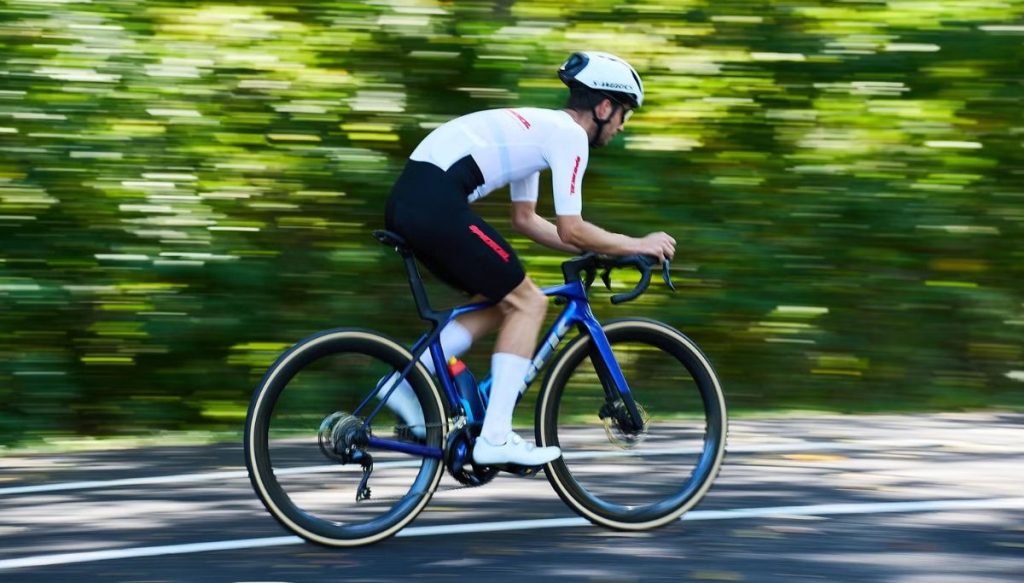
It’s important to keep in mind that when it comes to aerodynamics, rider position outweighs almost everything else. Your body accounts for as much as 80% of drag.
Last summer, I rode two Trek Madones in the same size. One was a top-tier build with a one-piece carbon cockpit and deep-section carbon wheels. The other was the base model, with a two-piece alloy bar and stem and shallow aluminium wheels. Riding both bikes in my normal position at a steady 280 watts, the expensive bike was about 2km/h faster on a flat road. No surprise there. But when I rode the cheaper bike at the same watts – but now with a flatter back, hinging a little more at the hips, lowering my torso and narrowing my shoulders while keeping my elbows relaxed – I reduced my frontal area enough to cancel out the speed advantage of the expensive.
This is the part of the aero conversation that is often overlooked. Gains from fit and position can outweigh those from more pricey and faster-looking equipment.
In theory, stacking aero gains should mean going even faster. But in practice, that only works if the bike lets you stay in your best position. On the less-expensive Madone, dialling in my fit was easy. The two-piece bar and stem made it simple to adjust reach and drop. If something didn’t feel right, I could swap parts and try again.
The more expensive bike was a different story. Its one-piece integrated cockpit came in limited sizes, and required a full brake-line replacement to make changes. That set-up may test well in a wind tunnel, but it also makes experimentation harder and more expensive. In practical terms, for most of us, such a bike makes ‘close enough’ a more likely outcome than ‘just right’. That’s the trade-off with integration.
The fastest position isn’t the most aggressive one – it’s the one you can ride for an hour, two hours, or the length of your hardest race.
Simply getting into an aero position isn’t enough. You also need to be able to sustain it. The moment that getting aero interferes with your breathing, stability or power, your speed drops. The fastest position isn’t the most aggressive one – it’s the one you can ride for an hour, two hours, or the length of your hardest race.
This is where fit-driven aerodynamics consistently beats gear-driven aerodynamics. A good fit, which comes after experimentation with stem length, bar width and stack height until everything lines up, often produces more significant real-world gains than buying components that boast wind tunnel advantages.
Aero gear is not plug-and-play. Buying the fastest thing doesn’t guarantee you’ll go faster. Helmets behave differently depending on head positions and body shape. Wheels interact differently with various tyres and frames, and also perform differently depending on wind angle and speed. Any set-up that looks great in isolated testing can fall apart in the real world.
Wind-tunnel testing and computational fluid dynamics (using computer modelling to predict airflow) show results under clean, repeatable conditions. Out on the road? The wind changes direction, fatigue changes posture, and the bike moves beneath you. A product that looks impressive on a chart may deliver a fraction of that gain, or none at all, once it’s part of a full system.
Note that none of this is an argument against aerodynamics. It’s an argument for understanding the concept holistically, rather than thinking of ‘aero’ as an isolated performance improvement.
The ideal approach to aerodynamics starts with a good, thoughtful fit on a bike that gives you flexibility to easily refine your set-up. The aero gains you stack on that base are likely to be the gains that you can actually use.
READ MORE ON: aerodynamics