Rocky’s Ride Into The Forgotten Kingdom
344 km. Nine days. No roads. And one Jack Russell in a handlebar basket…
The horizon doesn’t just lift at Sani Pass; it rears up like the spine of a sleeping beast. I knew this before I arrived, because David Alexander had told me it did.
The night before I crossed I was in bed in a backpacker’s in Underberg, reading his book, Sani Pass: Riding the Dragon. Alexander was the man who pioneered motor transport on this fearsome track in the 1940s, connecting Himeville in South Africa to Mokhotlong in what was then Basutoland, via a road that barely deserves the name.
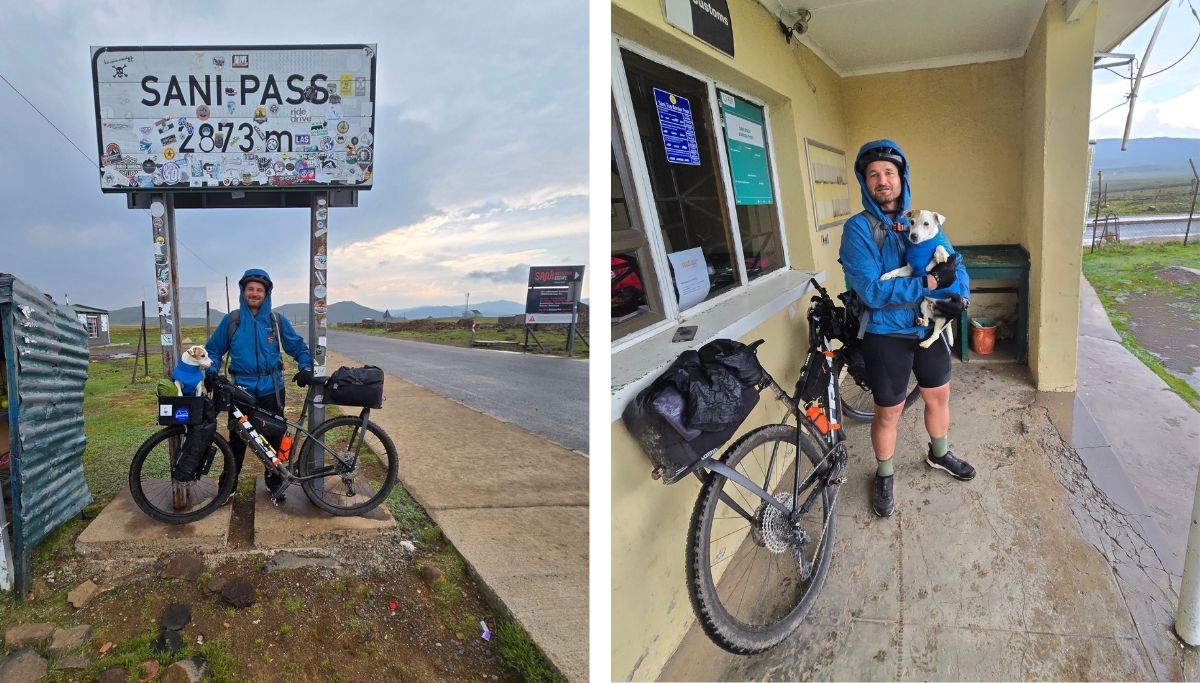
In the morning I would push a loaded bicycle up 925 vertical metres of loose rock and switchbacks to reach the Lesotho plateau.
He wrote of a landscape that demands a specific kind of penance; a place where the Dragon – the uKhahlamba-Drakensberg – does not tolerate the unprepared. In the morning, I would find out why.
Rocky was asleep, lying on my feet. Ten years old, a rescue Jack Russell and a veteran of several expeditions across Namibia; entirely unbothered by altitude. Outside, clouds sat heavily on the escarpment and wind moved against the hostel window. In the morning I would push a loaded bicycle up 925 vertical metres of loose rock and switchbacks to reach the Lesotho plateau. Alexander had done it with a motor; I was doing it by stubbornness.
MATATIELE TO UNDERBERG / 7-8 FEB 2026
Testing the Rig
The trip began on 7 February 2026 in Matatiele, Eastern Cape, at just under 1 500 metres above sea level. It was properly cold, even though it was summer. Jacket on before the wheels turned. Mist sitting low across the Eastern Cape hills, everything damp and green and grey.
The first two days were the preamble: 132km of gravel and tar, rolling through the foothills of the Drakensberg towards Underberg. Nothing savage, but nothing flat either. Day 1 always tells you something you didn’t know before. The bike, the bags, the kit… All of it getting its first honest read.
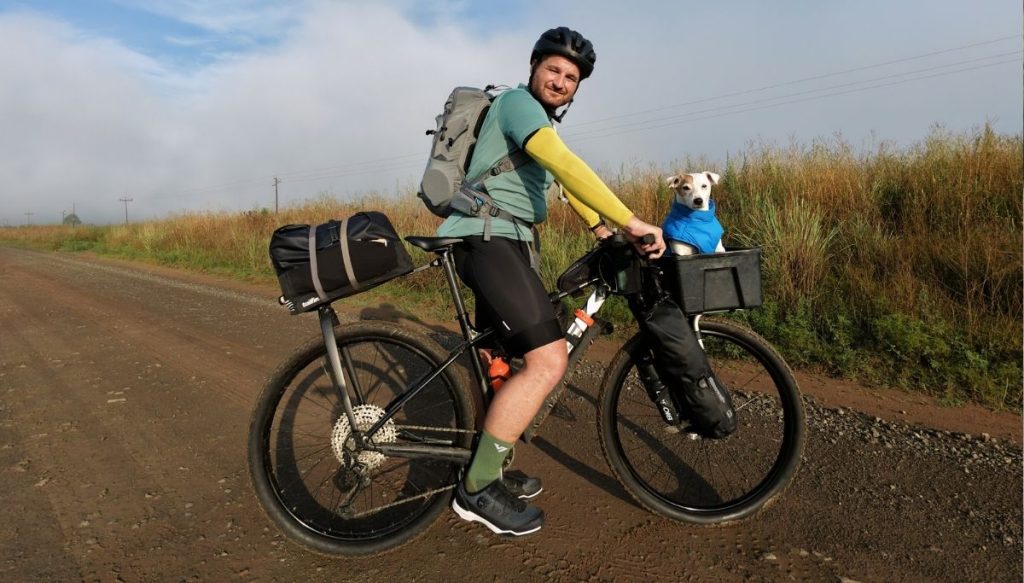
Rocky rode in the handlebar basket, which is where he spends most of his time on these expeditions. He’s not a novelty – he’s expedition crew.
At the village of Swartberg, a spaza shop provided the essentials: white bread, processed cheese, polony, and Purity baby food for dessert. Standard bikepacking cuisine.
The shop manager, Raza – an Indian immigrant, fluent in Xhosa and Zulu – helped me track down a local contact for accommodation. In small rural towns, local knowledge matters more than any app. I finished the day at Tafeni Cottages, on an idyllic farm north of Swartberg. A quiet evening to end a solid first day.
Day 2 dawned with criminal activity. The two Labradors from the cottages, who had been allowed to sleep in my room overnight, ate Rocky’s food while I was asleep. All of it. I stood there holding the chewed remains of the bag, trying to decide who looked more guilty. Neither offered a confession. Neither looked remotely sorry.
The ride to Underberg was mostly undulating tar, with a couple of proper climbs thrown in to keep things honest. Somewhere along the way a sign appeared: Welcome to the Southern Drakensberg. It registered immediately – not the sign itself, but what it meant. The mountains were starting to become real.
I rolled into Underberg dry, which felt like a minor victory. That evening I stocked up properly. Five days of food for what was to come: Oatso Easy, Forever Fresh dehydrated meals, energy bars, droëwors, biltong. I was already carrying more than I needed for myself. Managing Rocky’s food on these trips is often more complicated than managing my own.
But Sani Pass was coming. After the South African border post, everything was about to change.
THE DRAGON / 9 FEBRUARY 2026
Up and Up
Sani Pass is not a road. It is a living thing. It has moods. It has patience. It waits.
Alexander’s book opens with a warning. Sani Pass, he writes, is not a road. It is a living thing. It has moods. It has patience. It waits.
I thought about that on the lower section – 35km of steady tar climbing from Underberg, with views of farmland giving way to rising mountain terrain. You feel Sani before you properly see it. The road narrows. The air cools. The horizon lifts and keeps lifting. Traffic thins to mostly 4x4s heading up or back down.
And, to my considerable surprise, taxis. All with new tyres. This must be the only place in South Africa where the taxis actually have road-worthy tyres! I found out later that the one-way trip from Underberg to the Lesotho border by taxi costs R200.
Beyond the South African border post, at 1 961m, the tar ends and the mountain takes over: just over 11km of climbing. Nearly five hours. Those two facts together tell you most of what you need to know about upper Sani Pass on a bicycle! For the last 8km, the gradient averaged 11.5%. Strava rates it HC: Hors Catégorie. The same classification applies to Alpe d’Huez; the difference is that on Alpe d’Huez, the road is paved, and there are no river crossings.
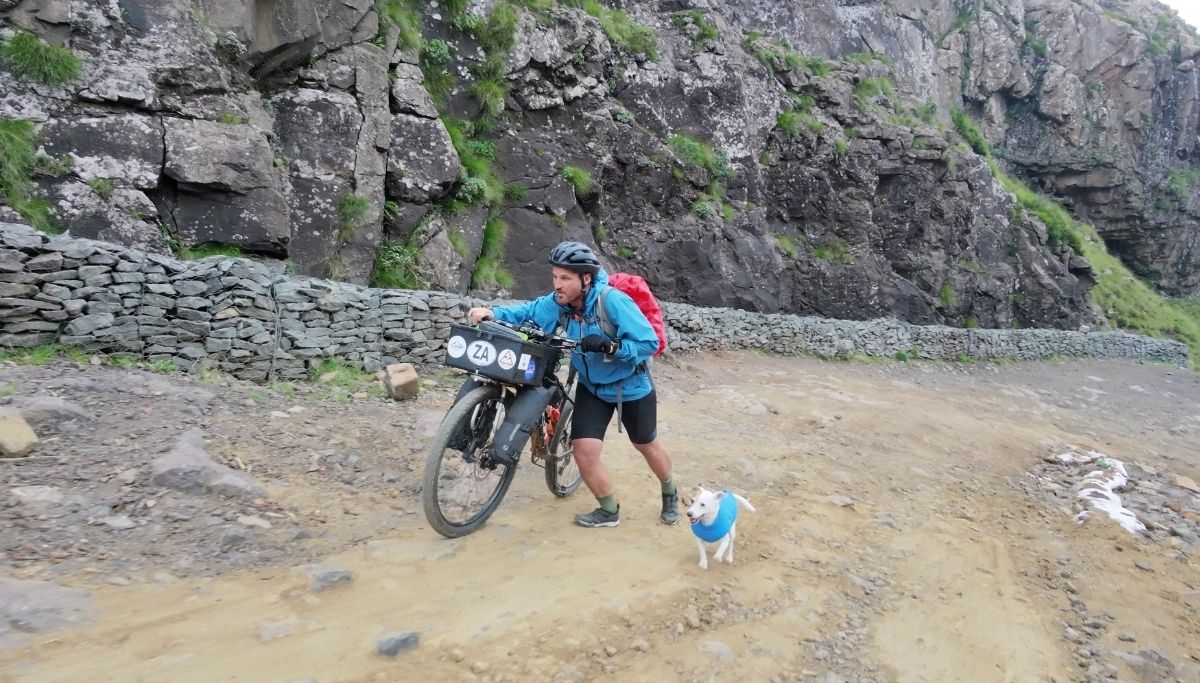
Rain came not long after our start. One minute, open sky – the next, inside a cloud. Changing into wet-weather gear on the side of the road. After that, very little actual riding happened; it was mostly pushing. Loose underfoot, steep enough that the rear wheel lost traction on anything but the most conservative line. Thunder, somewhere behind the cloud. The cliffs disappeared and reappeared, into the mist and back again, without warning.
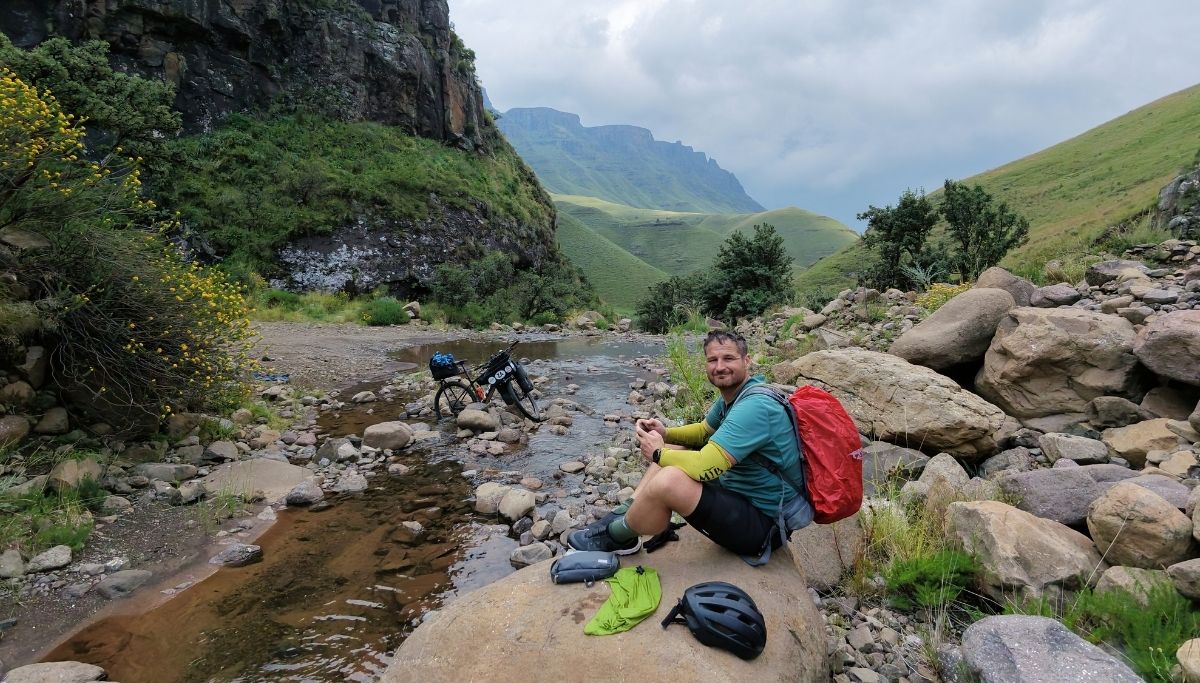
At a river crossing, I stopped for photographs. The bike tipped and went in. In the scramble to pull it out, Rocky’s sunglasses went downstream. Gone.
People often ask why Rocky wears sunglasses. It’s not for show. He has no pigment in his left eyelid, which makes that eyelid prone to sunburn, especially at altitudes where the UV exposure is more harsh. I learned that the hard way in Namibia.
On that trip I hadn’t prepared for it properly, and ended up taping gauze over his eye with duct tape so he could still ride in the basket all day. It worked, but it wasn’t ideal. Since then, the sunglasses have been standard kit. Every morning and evening I clean his eye and apply Maxitrol drops to control inflammation. When it’s required, he also receives Rimadyl for anti-inflammatory support.
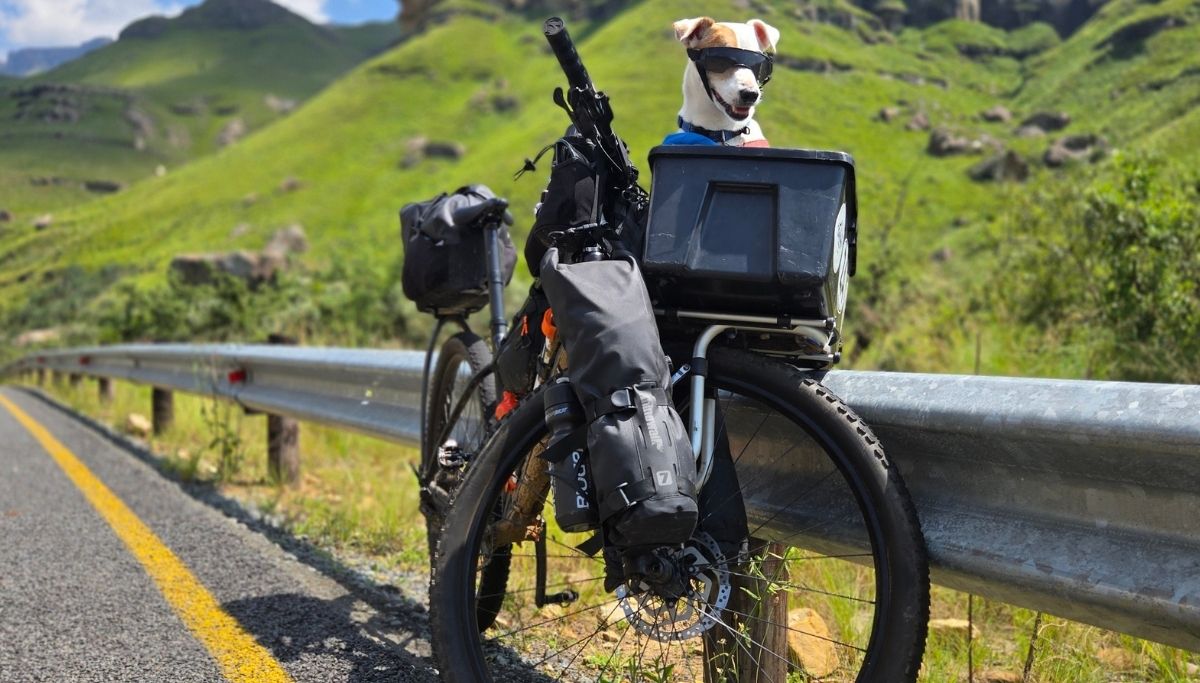
Rocky’s an exceptionally fussy eater. At home, he’ll sometimes go two days without eating. You can put a steak in front of him; if he decides he’s not eating, then he’s simply not eating.
That temperament doesn’t change in the mountains. In Namibia I leaned heavily on biltong, because it was easy to carry and it’s calorie-dense. It worked, but it had an unintended side effect: too much dried meat left him constipated, which in turn produced truly horrendous flatulence. Inside the confined space of a tent, it was not pretty.
For this trip, I packed a veterinary laxative paste as a precaution. Fortunately, we never needed it; Rocky’s digestion held up fine across the escarpment.
Sani was relatively busy. Foreign tourists and 4×4 tour operators went up and down past me, all day long. If it’d been just me – a slightly overweight, middle-aged man pushing his bike into the clouds – nobody would’ve cared. Add a Jack Russell in a basket, though, and suddenly the whole mountain loses its composure. Windows come down. Fists go up. Cheering from passing vehicles, like I had my own travelling support crew.
A couple of people stopped to photograph Rocky. He soaked up the fame; I kept pushing.
Alexander described something similar: the pass as a kind of theatre, where the mountain performs and humans play their small parts. Up there, in the cloud and the loose rock, with Rocky watching from his basket with his characteristic calm, the weight of the thing pressed down in a way that’s difficult to explain. It wasn’t distress. It was something closer to awe.
There were moments when I stopped not because I was finished, but because the altitude, the effort and the reality of being in that place with Rocky had overwhelmed me. I stood still on a switchback and looked out at the cliffs disappearing into grey, and I understood what Alexander meant about ‘penance’.
At the Lesotho border post, the formalities were simple. Entry fee R100, paperwork handled without fuss. Rocky’s vaccination certificates were ready, but never requested.
I stayed at Masobasoba Lodge that night, on the plateau, about two kays beyond the border. Solar lighting only; no grid electricity. Cold and quiet. The food was simple, and properly good. After five hours on the pass, and three more just to get there, food mattered more than anything else.
THE PLATEAU / 10-13 FEBRUARY 2026
Hike-a-Bike Heartland
I’d planned for a recovery day at Sani Top, but my rest day was… not restful.
I took the bike out for a short reconnaissance ride, leaving the road and rolling onto the plateau, trying to understand what the terrain ahead was actually going to require. On a screen, the GPX track looks straightforward enough. Up there, it was something else entirely. Highland ridges rolled in every direction, with no clear road and no obvious line.
That was also when I found the broken spoke. My rear wheel had developed a buckle. Not catastrophic; but not trivial, either. On rough, high-altitude tracks, a compromised wheel shifts the margin for error in ways you’d rather not think about.
Power was becoming an issue too. One of my three battery banks was running low, and once you leave Sani Top, there are no guarantees. I cycled back to the border police post and asked if I could charge it. They were happy to assist.
I tried to get a drink at Sani Mountain Lodge, the ‘highest pub in Africa’ at around 2 874 metres. But no booking meant no entry, not even for a Coke. It struck me as an odd approach in a place where most travellers arrive windswept and unannounced. I left mildly irritated, and found a small local tavern instead. Cold drink. Packet of chips.
A Basotho boy came in, maybe 15 years old, wearing gumboots and a traditional blanket. He bought two loose cigarettes, emptied them out and rolled himself a spliff using the tobacco as mix. No drama. Up here, the land shapes people early – you see it in small details like that.
Alexander wrote about this quality in the mountain people, too: a self-possession that comes from living at altitude, from working terrain that kills the careless.
The forecast showed strong wind and sustained rain for the following day, possibly worse on the ridgelines. The valleys ahead were long and exposed. No quick exits; no easy bail-outs. No one coming through behind me. A buckled wheel, incoming weather, remote terrain. A dog depending on my judgement.
It was supposed to be a rest day. It didn’t feel like one.
The next four days – 11 to 13 February – were the traverse proper; a combined 39.4km that took the better part of three days to cover. Those numbers look modest, until you understand what they represent: no roads, repeated ridge-valley-ridge cycles, all of it above 2 800m in altitude, with a high point of 3 283 metres on the Mashai Massif.
Very little of it was rideable; most of the day was spent pushing. And on the steepest sections, I leapfrogged the load: remove the Tailfin cargo pack, carry the backpack and bags up the ridge, stash them, walk back down for the bike, repeat.
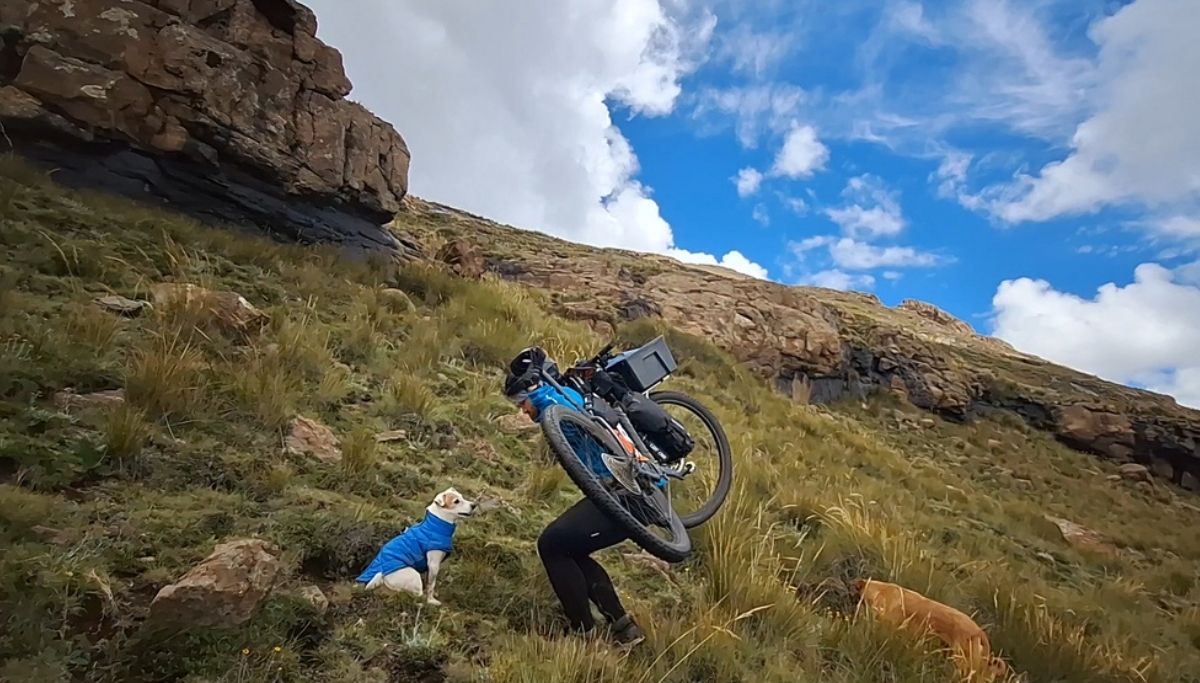
Distance ceased to matter. The next 200 metres became the only metric. I settled into a carrying system: left shoulder under the frame, rear wheel pointing forward, left hand gripping the rear stay. Squat. Lift. Walk a few steps. Set down. Recover. Repeat.
Rocky was completely at ease. Three thousand metres of exposed highland does not trouble him. He’s disciplined on expeditions, and seems to understand what’s required. Given open ground he runs freely across the plateau, introducing himself to shepherd dogs with appropriate canine formality, then trotting back and hopping into the basket when it’s time to move.
The usual introductions were observed with the plateau dogs: a brief circle, a measured sniff, territory assessed and diplomatically resolved.
The shepherd dogs were remarkable. Some lean and short-coated, built for speed across open ground. Others larger and heavily furred, coats suited to sleet and freezing nights. Not pedigree stock; landrace mountain dogs, shaped by necessity. A sharp whistle or the suggestion of a stone in hand was enough to bring instant order. These were working animals, not companions.
By Day 6, our food was running low. The energy bars and trail snacks were almost finished. Rocky’s feeding strategy had unravelled entirely. I’d carefully portioned kibble into Ziploc bags, and mixed in chopped droëwors and biltong to boost the calories. It was a solid plan.
Rocky disagreed. He refused the kibble mix outright. What he did take a liking to were my natural food bars, which he worked through with no hesitation. That left me short. So I started picking the rejected biltong pieces out of his ration bags and eating them myself.
Around midday on Day 6, a squall hit the ridgeline. I threw down the tent footprint and pitched only the flysheet. No inner; just enough structure to get out of the weather. Guy lines taut. Rocky and I crawled underneath, while the ridge disappeared into grey.
For half an hour we sat there on the escarpment, eating rehydrated food under a flapping flysheet while the squall pushed through. Then, as quickly as it had come, it moved on. We packed the wet sheet, loaded up, and kept pushing.
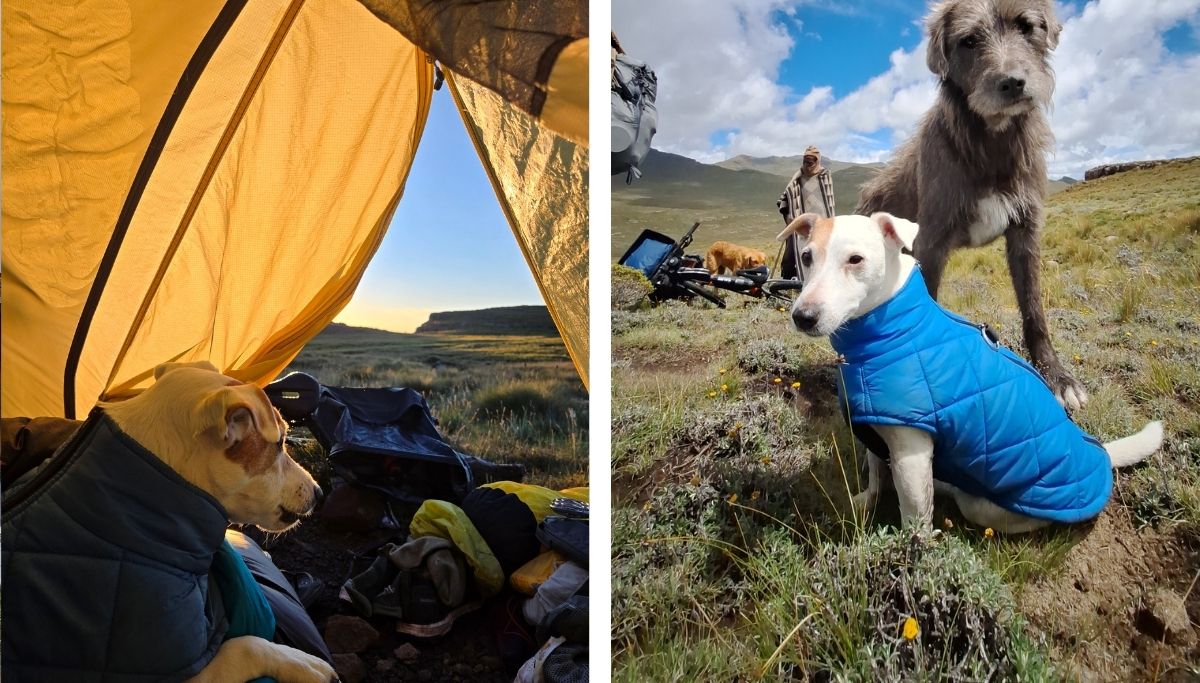
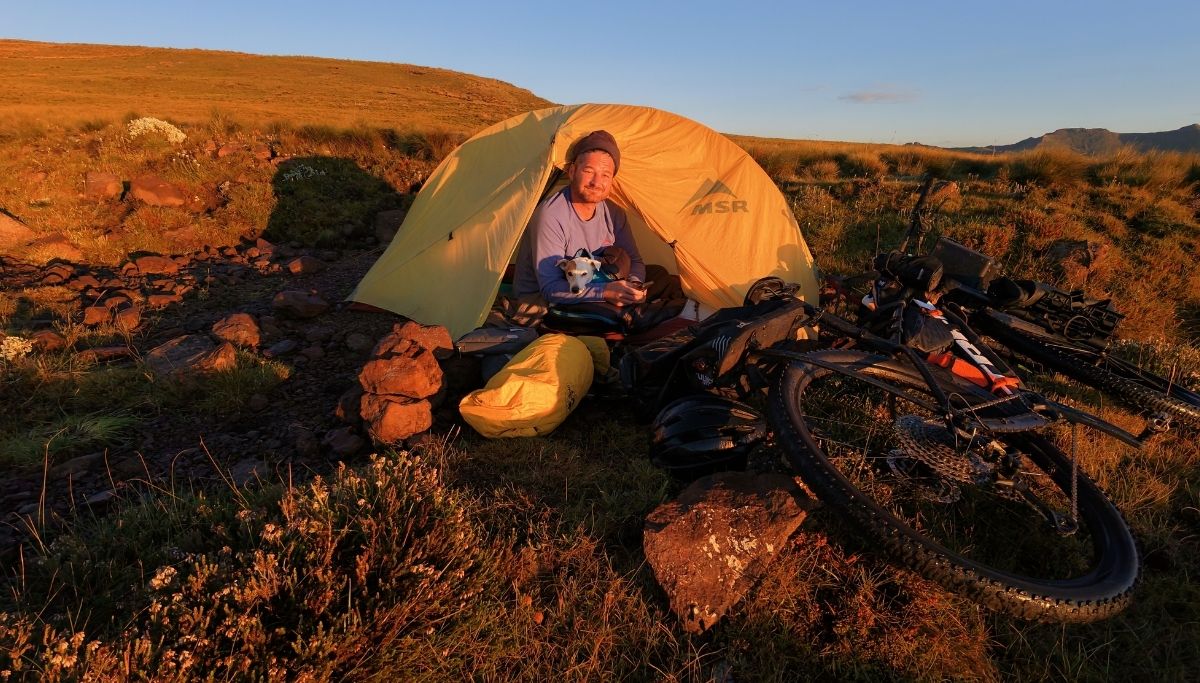
Rocky sleeps inside my sleeping bag at night. Not that he gives me any choice, but it’s the simplest way to keep him warm. Sometimes he overheats and starts panting, and I have to open the zip to let him cool down before closing it again. He doubles as a hot water bottle, which keeps me toastier than I would be otherwise.
With colder ground ahead, I was worried about Rocky’s comfort; keeping him warm was a priority during the traverse. I cut a hole in my microfibre towel and draped it over him as a rough poncho, then pulled his bomber jacket over that. When the temperature really dropped, both layers stayed on.
On the morning of Day 7, I woke to low, dark cloud, and wind pushing hard against the tent fabric. The forecast the night before had not been encouraging. I wasn’t going to commit to the next section without checking properly. I packed light, and hiked 1.6km up to the escarpment ridge to find cell signal and confirm the weather.
When I had reception, I sent my girlfriend Tracy a WhatsApp location pin. If something went wrong, at least someone would have a starting point to try and find me.
That ridge also held my emergency exit, should I need it: the Rhino Horn Trail – the only clearly navigable descent I’d identified on this section. From just under 3 000m in altitude, it drops more than a thousand vertical metres in six kilometres. Average gradient around 17%, with steeper pitches beyond that. Loose and eroded. Not rideable under load.
It would have been a shoulder-carry descent into the Garden Castle side beneath Rhino Peak. Hours and hours of toil, and possibly the end of the bike if things went badly. It was a legitimate option for escape, but not a comfortable one.
I stood at the high point and watched the weather system move across the plateau. Heavy clouds rolled through; but they weren’t solid, they broke in places. It didn’t look as severe as sunrise had suggested. Standing above that Rhino Horn descent, with the weather moving in, I turned away from the exit and chose to press on. By the time Rocky and I walked back into camp, patches of blue were showing through.
Later that day, beyond the Matebeng ridgeline at roughly 3 000m, I met an elderly man.
I greeted him: “Dumela, Ntate Moholo”, which means “Hello, Grandfather” – a respectful way to address an older man in Sesotho. He was probably in his sixties. We had no shared language beyond my greeting. We spoke with our hands. I pointed toward Mashai Peak, and offered R100. He nodded.
I stripped the Tailfin pack from the bike and handed it, together with my First Ascent backpack, to my newly appointed sherpa. He carried both while I pushed or shouldered the bike.
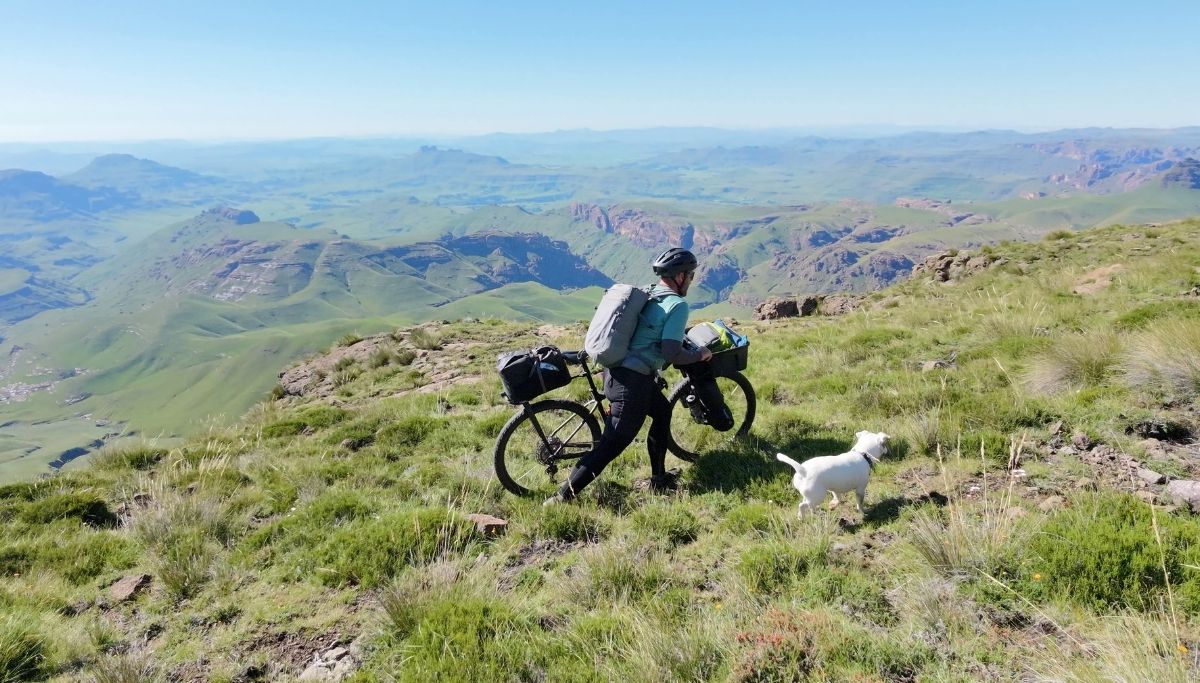
Mashai is not a forgiving place. We followed a ridgeline for several kilometres through scrub, rock and small streams; the old man did not slow down. He moved as if the terrain was flat. I was sweating heavily, and more than once had to ask him to wait. When we stopped, I took photographs. Part documentation, part recovery.
As we travelled along the contour line, my escort shouted across the slope to another man moving a small herd of horses, riding bareback on a Basotho pony without a saddle or bridle in sight. The ponies were compact and sure-footed, completely at home on the broken ground where I was fighting for every step. They scaled the mountainside with calm efficiency, threading through rock and grass without hesitation.
Alexander had written about the Basotho ponies too – about how they made the land look easy, in ways that humbled every outsider. Nothing has changed.
Near the neck below the summit, we realised we were slightly off the GPX line and on the wrong side of a deep ravine. We traversed around the massif to regain the track. Time lost. Energy spent. At that point, my guide turned for home. He handed my loads to a teenage shepherd who happened to be nearby. The boy took both bags and moved off up the ridge in his gumboots without breaking stride.
Again, the Mashai ridgeline demanded repetition. Squat. Hoist. Step. Set down. Recover. Repeat.
The altitude topped out at 3 283m, after which we descended into the valley between Mashai Peak and Walkers Peak as another weather front rolled in, fast and heavy. I chose not to attempt Walkers. The next morning’s descent would be demanding enough, and the young shepherd had already carried more than his share. I paid him R100. He turned and walked back up the slope without a word.
I set up camp in the valley near the escarpment. Three small streams converged nearby, joining to become a clear mountain river that ran past my tent. The sound carried through the basin, a constant bubbling over rock and gravel. Clean water, straight off the plateau.
ISICATULA AND DOWN / 14 FEBRUARY 2026
Into the Valley
During my months of planning, the Isicatula descent was the section that had kept me up at night. On the maps it looks brutally steep. I’d found a faint GPS heat-map line on Ride with GPS: someone had been through before, but not with a loaded bike.
The maps were correct: the descent off the ridge was one of the most hair-raising I’ve ever done.
The route was steep, loose and wet. Every now and then the mist would close in and erase the horizon. In places, there was no obvious trail; just slope and gravity. I stayed glued to the line on my Garmin Fenix 7. At one point I lost control of the bike completely – it somersaulted down the slope, and my heart stopped. Thankfully, there was no damage.
And the rain didn’t let up. It was freezing. Rocky looked absolutely miserable; I’m pretty sure I did too. River crossing after river crossing… I stopped bothering to take off my shoes, though I was in full wet-weather gear.
Our food was minimal too. I cold-soaked a Forever Fresh dehydrated meal and ate it sitting in the rain; Rocky and I huddled in the cold and shared it. I let him eat straight off the leg of my K-Way waterproof pants. We were both taking strain.
When you’re cold, wet, tired and slightly afraid, you keep moving because you have to. You don’t feel heroic. You just focus on the next safe step.”
And we were at that juncture where the story shifts from adventure to commitment. When you’re cold, wet, tired and slightly afraid, you keep moving because you have to. You don’t feel heroic. You just focus on the next safe step.
Eventually the terrain softened. Basotho huts made of stone and thatch dotted the base of the valley. Shepherds and dogs moved among small flocks. The mountains opened into a broad green valley, isolated and strangely timeless. Rolling grassland stretched across the basin. Horses grazed on distant slopes, and suddenly, the escarpment was behind us.
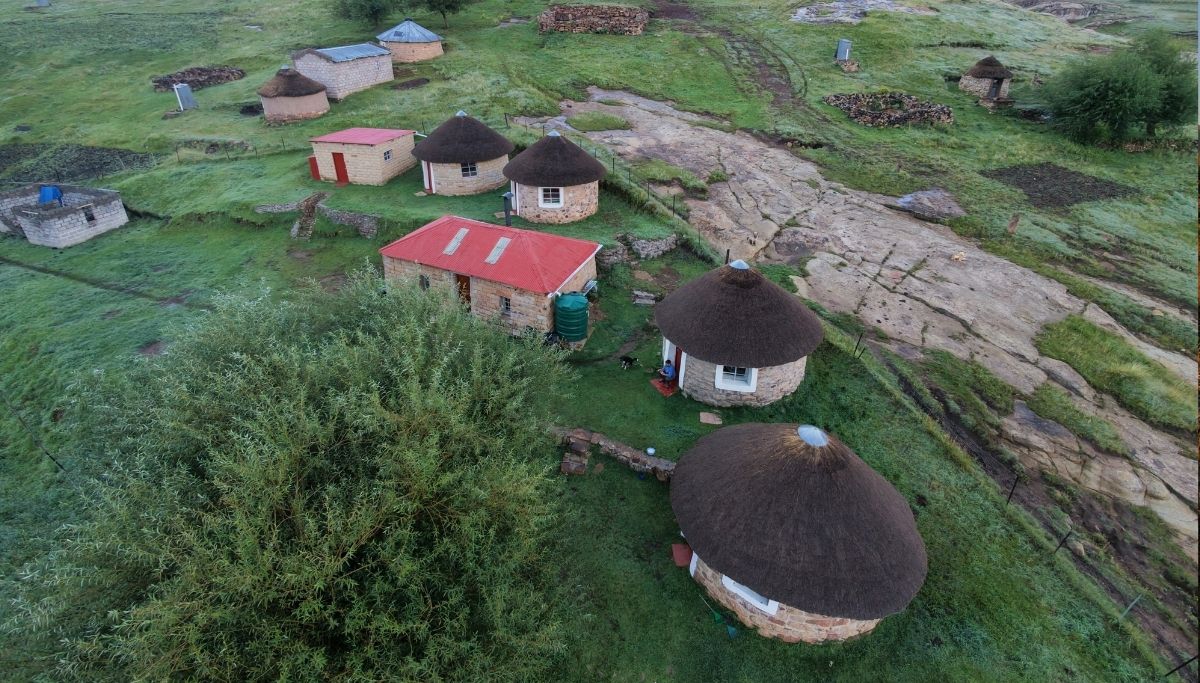
Lesotho is known as the Mountain Kingdom, and often referred to colloquially as the Forgotten Kingdom. This valley felt like the epitome of both.
The last stretch toward Khotso Lodge near Thamathu village followed deep cattle tracks. For the first time in days, I could ride with some rhythm. Proper forward motion. After the exposure of Isicatula, those tracks felt like a highway.
Khotso Lodge – khotso means ‘peace’ – is built in traditional Basotho style. Round huts, gas heaters, thick warm blankets, a paraffin lamp for light. I had a hot, gas-powered shower that felt like a minor miracle. My clothes were positively humming with sweat and several days of wild travel.
At a nearby spaza shop I bought polony, biscuits and chocolates. I made friends with a small grey kitten, and briefly considered whether it would fit on the bike for the ride home.
I managed to barter one of my power banks for a USB-C cable. I probably lost out in the deal, but both my cables had broken during the trip, and without even one I couldn’t charge anything. Later, a Basotho gentleman loaned me his power bank, which allowed me to charge my drone and phone almost to full. The village runs on solar, but with so little sun that day, charging wasn’t really an option.
Dinner was moroho – a traditional dish of cooked leafy greens, usually foraged varieties, served with pap. That night it was made with spinach instead of wild greens. It was simple, hot, and exactly what I needed.
THE END / 15 FEBRUARY 2026
Downward to Home
Recovered and energised for the last day, I replotted my route. I decided not to exit at Qacha’s Nek and instead aimed for the Ramatseliso border post, saving roughly a day’s riding. I was all adventured out, and ready for home.
The morning began on dirt tracks and muddy gravel, rolling through those wide, grassy valleys. A scruffy, long-haired shepherd dog followed us for several kilometres before eventually losing interest.
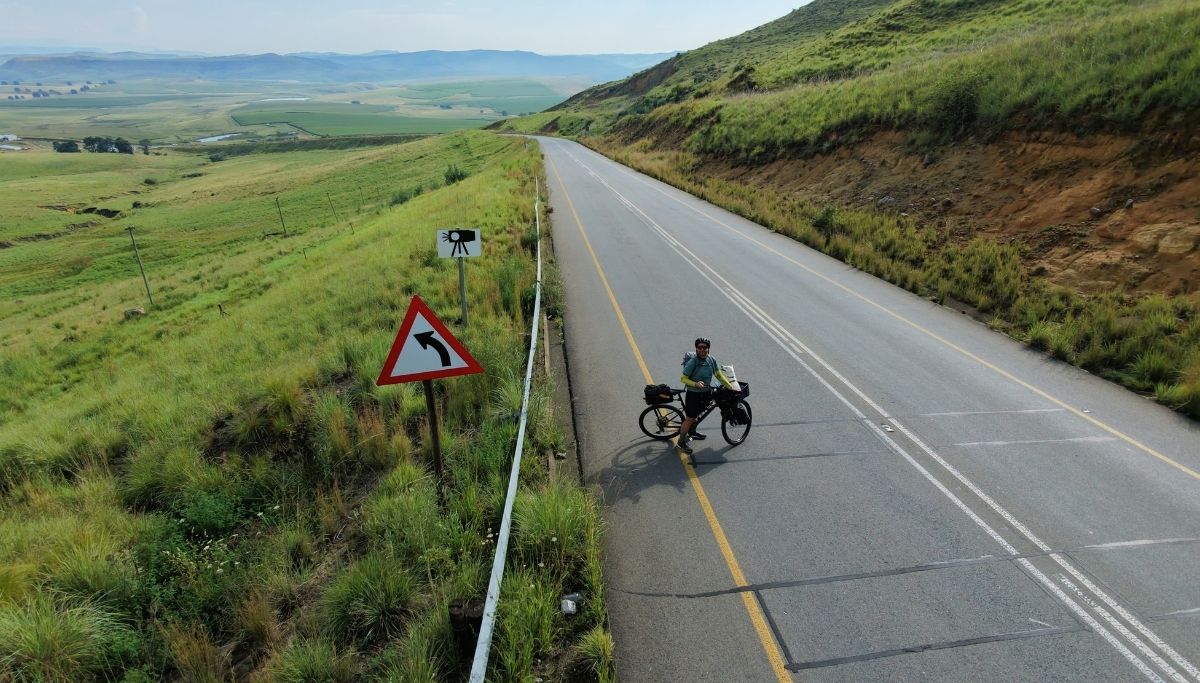
Then I hit the tar. Glorious, smooth tar, near Sehlabathebe National Park. Probably Chinese-built. After days of punishment, it felt unreal. Rocky finally relaxed properly. He normally sits upright in his box, alert and scanning; that day he settled down fully, and even managed a few winks.
At the border post on the Lesotho side, I passed a tavern on the way to customs. As I cycled past, a drunk-looking man in tattered clothes followed me. I assumed he wanted to talk nonsense. Turns out he was the immigration officer – a sergeant. He stood swaying, with the stamp hovering above my passport for what felt like five minutes, while trying to talk. Eventually I secured the stamp.
On the South African side, everything was straightforward. No issues with Rocky or his paperwork.
I walked back to the Lesotho side for food before tackling the Ramatseliso descent. At the tavern, I bought makoenyas – small vetkoek, does anyone really say ‘fat cakes’? I grew up in the Free State, and my dad ran a business in Lesotho. When I visited him in Maseru as a child, I would eat makoenyas near his office and drink milk from a plastic sachet. The taste hit instantly. Childhood.
The descent of Ramatseliso was magnificent. Long gravel switchbacks dropping towards home. I pushed hard on that final stretch. Near the end it starts to feel like a race, even when no one is watching.
I had travelled 344 kilometres in nine days, from 1 432m to 3 283m and back again, finishing where I’d started. No fanfare. No crowd. Just me and Rocky rolling back into Matatiele.
David Alexander also ends his book at the bottom of a pass, engine cooling, the Dragon behind him. There was no fanfare in his telling either. Just the quiet of arrival, and the knowledge that the mountain had allowed him through.
The escarpment was behind us, but it didn’t feel conquered. It felt respected.
About the author
Sean Fraenkel is an offshore saturation diver by profession; he lives in Glencairn, Cape Town. You can read about his epic journey through Namibia with Rocky in the May/June 2025 issue of Bicycling, and follow the intrepid duo on Instagram: @rockysride
Mountain Motoring
Sani Pass: Riding the Dragon by David Alexander was first published in 1992. It documents the author’s early adventures in pioneering motorised transport up Sani Pass, connecting Himeville in South Africa to Mokhotlong in Lesotho. Copies are available through South African antiquarian booksellers.
READ MORE ON: Bike adventure bike packing bike tour lesotho