
From Nervous to Confident: How to Become a Better Mountain Biker
Improving your skills will lead to more daring rides.
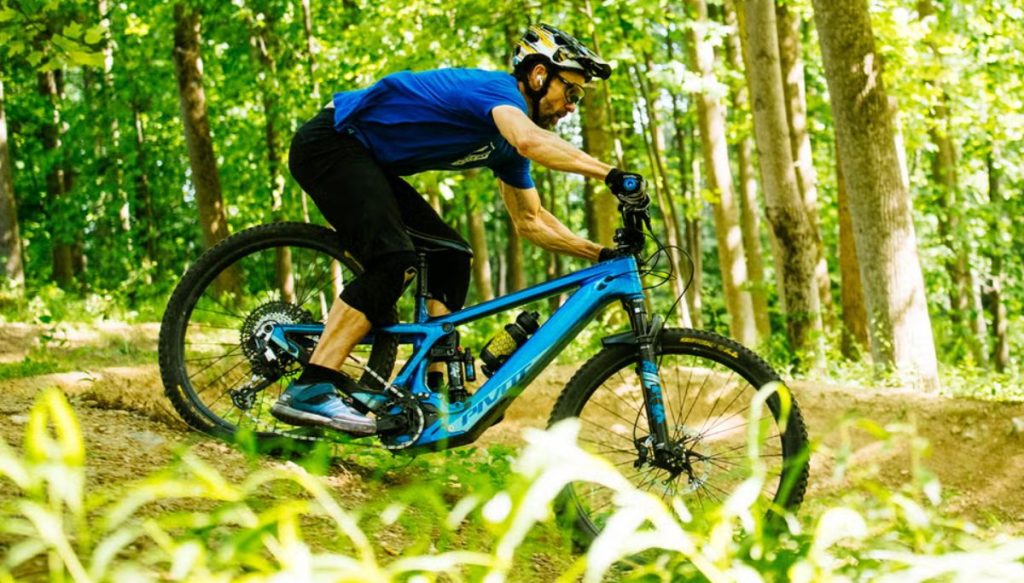
What makes a cyclist leave the roads and head to the trails? Is it the endlessly changing terrain or the courage it takes to find your way on an unfamiliar mountain? Aside from mastering their bikes, skilled MTBers also know how to read the terrain, including the bumps that come from rocks, trees, roots, and dirt — without hesitating on their way up and down those hills.
To improve your mountain biking skills and technique, you’ll want to focus on a few elements:
1. Progress at Your Own Pace
Mountain bike coach Jonny Gabor suggests you adopt the rate of perceived exertion scale (RPE) as an overall measure to keep track of the difficulty of your rides.
A level one ride would be easy with little to no challenge. This would be what you want to aim for when you’re new to mountain biking. A ride on a technical or hill trail might be closer to the seven to 10 range of the scale as an all-out effort, maybe even a ride you can’t complete. To use RPE effectively, consider keeping notes after each ride, including the trail name, the distance you rode, highlights such as views and hills, and, then, finally, an overall rating of the difficulty of the trail.
As you do this, also note your ability with these specific techniques. This will help you become a better, more confident mountain bike cyclist.
2. Be Loose and Get Out of the Saddle
When you head out onto the trail, try to sit “loose” on the bike. Don’t grip your handlebar too tightly, keep your shoulders relaxed, and remember to let the bike do the work and respond to the ride. Posture is also important. Because the terrain is constantly changing, you need to sit upright and keep your eyes focused on what’s ahead.
“In mountain biking, we always want to absorb the terrain.”
If you’re afraid of falling, understand that sinking into the saddle to remain steady is not the best way to allay those fears. Instead, practice getting in and out of the saddle as you get used to your bike and its reaction to different terrains. Staying in the saddle is the mark of a newer, more nervous rider.
You will want to use different body positions on ascents than descents.
- On an ascent, you can lean forward a little
- On a descent, you want to lean back a bit into your seat
As you look down the trail, if you notice a rock or root, that’s a sign it’s time to get out of the saddle. Vision is one of the most important — and overlooked — skills in mountain biking.
New riders often focus on the obstacle directly in front of them. More experienced riders look farther ahead, scanning the trail and identifying the line they want to ride before they reach it. This allows them to make smoother decisions and react earlier to changing terrain.
When you get out of the saddle, don’t move forward over the handlebar. Instead, remain balanced both on the bike and with the bike on the trail. Move your butt toward the rear wheel, which will help you not go over the bars if you do hit an unexpected rough patch.
This is also the time to work with your dropper post, if you have one. Put the seat down first, or as you stand, so that it’s not in your way. You’re going to have to practice raising and lowering the post as you ride so that the seat is where you want it when you sit again.
As you learn how to look ahead and steer both over the ground underneath you and toward the ground in front, you will eventually respond to the bike rather than trying to force it to stay steady. It is the rock and roll of a mountain that cyclists enjoy—you aren’t trying to turn the landscape into something that feels like a flat road ride.
3. Understand Your Bike’s Brakes
You don’t want to have a stop-and-start feel as you go up and down and over the different terrain. Braking mistakes are one of the biggest causes of lost control on the trail, says Gabor.
Think about how to best modulate your usage of brakes. Your front brakes, on the left handlebar, are more powerful than the rear brakes (on the right). Most braking should be done with the rear, and the front brakes are there to assist, and only in a straight line, never hard through a corner. You may sometimes need a little rear brake in a corner to stop accelerating.
Cornering Fundamentals
- Brake before the corner
- Look through the turn
- Avoid heavy front-brake use while turning
- Maintain momentum through the apex
- Focus on exit speed
4. Make Sure You’re Set Up Properly
In order to feel the flow of your mountain bike — especially because the terrain is impeding a sense of flow — you’ll want to make sure your bike is set up properly so you can maintain good cadence. You want to check your suspension and your tyre pressure before each ride. If the tyre pressure is too low, they won’t roll across rocks.
Also, use a gear that allows you to pedal with some resistance. The ride shouldn’t feel effortless or like a spin, but it should also make it easy to get up a hill. Speed is your friend when it comes to getting over obstacles.
5. Scan and Practice (Practice, Practice)
One aspect of mastery for a mountain bike rider is someone who is two or three seconds ahead of the upcoming landscape, so they are looking as far down the trail as possible and “picking their line.” This means giving themselves enough time to feel confident that they are going down the safest — and maybe even the most fun — part of the trail. You don’t want to have to dodge trees and boulders so much that you actually have to start and stop your ride.
Gabor says there is nothing wrong with hiking back up with your bike and trying a different route. That’s building experience, and it leads to better results on every ride. Also, it’s fun, and mountain biking is nothing if not fun. This element of play is one of the best ways to improve.
You may notice something that is impossible to ride through or around on a trail and, at that point, Gabor will actually get off his bike, lean it against a tree, and scope out the situation. He makes decisions — off the bike — about his comfort level with the terrain.
“To gain more confidence on any trail, a rider has to be continuing to put in their time riding not only their local trails but new trails as well,” says Gabor. “New trails can teach a rider to challenge themselves and work on line reading skills.”
6. Strength Train Your Core and Upper Body
Many people new to cycling will focus on strengthening their legs, but Gabor says he prefers to have his clients start with full-core work to stabilise the body. A strong core will help your extremities be more efficient and it will lead to stronger, controlled movement on the bike.
In fact, Gabor emphasises shoulder strength with his clients because they initiate pulling and pushing on the handlebar. His suggestions for a quick workout:
- planks
- side planks
- push-ups
- wall sits
This article first appeared on bicycling.com
READ MORE ON: MTB Technique Skills